
Small changes in timing, supply levels, communication, and cleaning quality often reveal a declining service standard before complaints become frequent or obvious.
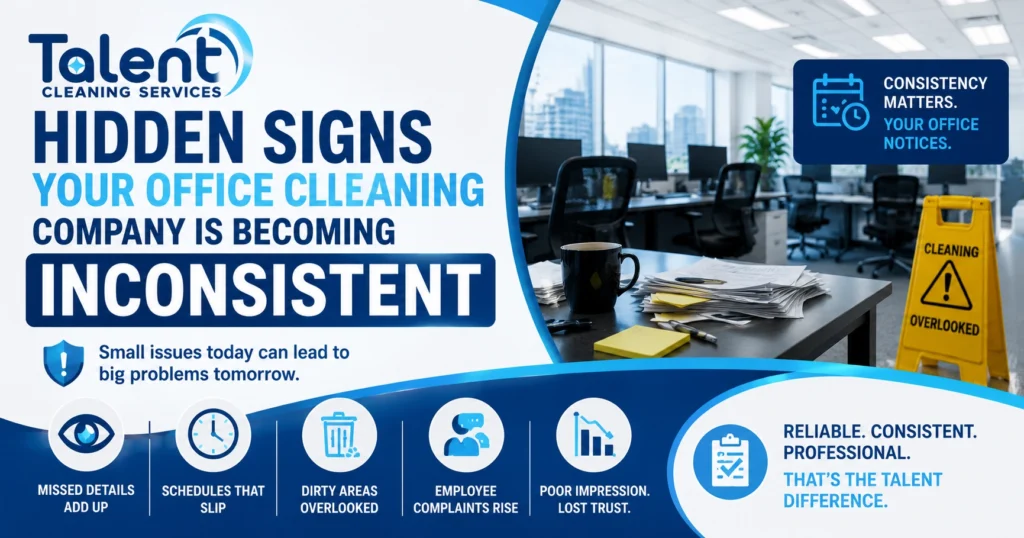
An Office Cleaning Service becomes inconsistent when the promised cleaning routine is no longer delivered at the same standard, frequency, or level of attention. The first warning signs are usually subtle. Trash bins may be emptied while liners are forgotten. Restrooms may look acceptable in the morning but run out of supplies during the day. Desks may appear clean while corners, baseboards, vents, and shared equipment gradually collect dust.
The central problem is not one missed task. It is the loss of predictability across repeated visits. When the cleaning crew, schedule, inspection process, or communication system changes without clear oversight, small service gaps begin to accumulate.
Office managers should watch for changes in five areas: cleaning results, arrival consistency, supply management, employee complaints, and provider communication. A reliable company should complete agreed tasks on schedule, identify recurring problems, document exceptions, and correct deficiencies without requiring constant reminders.
If you are repeatedly checking the work, forwarding complaints, requesting basic corrections, or explaining the same expectations, the service is already creating operational friction. That is a strong indication that your current provider is becoming inconsistent.
What Does Inconsistent Office Cleaning Actually Mean?
Inconsistent office cleaning means the outcome changes from one service visit to another even though the office, cleaning schedule, and scope of work remain substantially the same.
One Monday, the restrooms are properly cleaned and restocked. The following Monday, the floors are clean but soap dispensers are empty. During another visit, the reception area looks polished while the break room counters remain greasy. Each individual failure may appear minor, but the pattern shows that the cleaning process is no longer controlled.
A consistent provider delivers an expected result within an agreed routine. This does not mean that every cleaning visit will be identical. Weather, office traffic, special events, maintenance work, and unexpected spills can change what the space requires. However, a professional provider should recognize those conditions and adjust without abandoning essential tasks.
The difference is simple:
- An isolated mistake is identified and corrected.
- A recurring inconsistency continues across multiple visits.
- A process failure affects several rooms, tasks, or schedules.
- A communication failure leaves the office manager responsible for finding and reporting every problem.
The real standard is not whether the office looks acceptable at a glance. The standard is whether the company can maintain cleanliness, sanitation, supplies, presentation, and schedule reliability without constant supervision from the client.
Why Do Cleaning Problems Often Remain Hidden at First?
Cleaning problems remain hidden because most offices do not inspect every room after every service. Office managers usually evaluate visible areas, such as the lobby, conference room, restrooms, and main walkways. Less visible spaces can decline for weeks before anyone connects the separate problems.
A trash bin under a desk may be missed occasionally. Dust may collect behind monitors. Fingerprints may remain on a glass partition. A break room microwave may receive only a quick exterior wipe. None of these issues alone proves that a company is unreliable.
The warning appears when the same type of omission happens repeatedly or when missed tasks begin spreading to additional areas.
Inconsistency Develops Through Service Drift
Service drift occurs when the actual cleaning gradually moves away from the original scope of work. The provider may still complete the most visible tasks, but detailed work becomes less frequent, less thorough, or completely irregular.
This drift often begins when:
- The original cleaning team is replaced.
- New workers receive incomplete instructions.
- Supervisory inspections become less frequent.
- The provider reduces the time allocated to each visit.
- The office grows, but the cleaning plan remains unchanged.
- Additional employees use the space without a schedule adjustment.
- Repeated deficiencies are corrected temporarily instead of being investigated.
A provider may respond to each complaint separately and still fail to correct the underlying system. If the restroom is restocked only after an email, the immediate problem is solved, but the supply management process remains unreliable.
Visible Cleanliness Can Hide Operational Weakness
An office can look clean while the service behind it is becoming unstable. Vacuum lines on carpet and polished reception surfaces create a strong first impression, but they do not confirm that the entire cleaning scope was completed.
True consistency includes:
- Restroom cleaning and supply replenishment
- Break room cleaning and food residue removal
- Trash and recycling collection
- Floor care in open and enclosed areas
- Dust removal from accessible surfaces
- Cleaning of touch points and shared fixtures
- Attention to entrances, conference rooms, and reception areas
- Completion at the scheduled time
- Reporting of damage, leaks, shortages, or unusual conditions
These tasks form an operational system. When only the highly visible items receive attention, the office may appear presentable while hygiene, supply availability, and employee experience continue to decline.
What Are the Earliest Signs That Cleaning Quality Is Changing?
The earliest signs are usually small deviations from the normal standard. They become meaningful when they repeat, appear in different areas, or require the office manager to intervene.
| Early signal | What it may indicate | Operational risk |
| Trash is removed, but liners are missing | Rushed task completion | Employees must correct basic details |
| Soap or paper products run out | Weak supply monitoring | Restroom complaints and hygiene concerns |
| Dust returns quickly in the same areas | Surfaces are skipped or cleaned irregularly | Visible decline and poor air quality perception |
| Different rooms are missed each week | No dependable checklist or inspection | Unpredictable service quality |
| Cleaning occurs later than scheduled | Staffing or route management problems | Disruption to employees or building access |
| Complaints increase without a major office change | Service quality is declining gradually | Lost employee confidence |
| The provider stops reporting issues | Reduced supervision or accountability | Facility problems remain unnoticed |
| Corrections last for only one visit | Symptoms are addressed without fixing the process | Repeated management work |
A single observation should be documented, not exaggerated. A repeated pattern should be treated as an operational issue requiring a structured response.
Are Certain Areas Being Cleaned While Others Are Regularly Missed?
Uneven cleaning across the office is one of the clearest early indicators of inconsistency. It suggests that the crew may be relying on memory, prioritizing visible areas, or working without enough time to complete the full scope.
Common examples include:
- The reception area is clean, but private offices remain dusty.
- Restroom floors are mopped, but partitions and dispensers are neglected.
- Conference tables are wiped, but chair arms and shared controls are missed.
- Break room counters are cleaned, but cabinet handles retain residue.
- Main walkways are vacuumed, but corners and spaces under furniture are skipped.
- Trash is collected from common areas, but individual workstations are overlooked.
Uneven results matter because office cleanliness is judged collectively. Employees do not separate the provider’s performance by task category. A full trash bin, empty soap dispenser, or dirty microwave becomes evidence that the entire service is unreliable.
Why Rotating Deficiencies Are More Serious Than One Missed Area
When the missed area changes from visit to visit, the company may lack a repeatable workflow. One evening, the conference room is skipped. During the next visit, the restrooms are not restocked. Later, the entrance glass is left covered with fingerprints.
This rotating pattern is more serious than one recurring technical problem because it suggests that the provider cannot control the complete service process.
A stable Office Cleaning Service should use a defined scope, route, task sequence, schedule, and quality control method. Workers may perform tasks in different orders, but the required result should remain consistent.
Are Employees Mentioning Small Problems More Often?
An increase in employee comments is a valuable operational signal. Employees use the workspace throughout the day and often notice changes before management does.
Early comments may sound minor:
- “The restroom was out of paper again.”
- “The break room still smelled this morning.”
- “My trash was not emptied.”
- “The conference table feels sticky.”
- “The carpet near the entrance looks dirty.”
- “Was the office cleaned last night?”
The key phrase is “again.” Repetition changes the meaning of the complaint. It indicates that the issue is no longer isolated.
Office managers should not dismiss repeated comments simply because each complaint involves a different task. Multiple small complaints can share the same root cause: reduced labor time, weak supervision, unclear responsibilities, staff turnover, or a cleaning scope that no longer matches office use.
Employee Complaints Are Operational Data
Employee feedback becomes useful when it is documented by date, location, and task. A vague statement that “the office is not clean” is difficult to evaluate. A record showing three restroom supply shortages and two missed trash collections within ten business days identifies a measurable pattern.
This information helps distinguish between a perception problem and an actual service failure. It also gives the cleaning provider a fair opportunity to investigate the cause instead of responding to general dissatisfaction.
Is the Office Manager Becoming the Unofficial Quality Inspector?
The strongest hidden sign of inconsistency may be the amount of management attention the service now requires.
A cleaning company is hired to remove work from the office manager’s routine. If the office manager must inspect restrooms, check trash bins, photograph deficiencies, restock supplies, send reminders, and verify corrections, the provider is transferring part of its quality control responsibility back to the client.
This creates a direct operational cost even when the contract price has not changed.
Consider the difference between these two situations:
| Consistent service | Declining service |
| Problems are identified by the cleaning team | Problems are found by employees or management |
| Exceptions are communicated promptly | Management must ask what happened |
| Corrections remain in place | The same issue returns |
| Supplies are monitored routinely | Items are replenished after complaints |
| The agreed schedule is predictable | Arrival and completion times vary |
| Supervision is handled by the provider | The client becomes the inspector |
The central question is not merely, “Was the office cleaned?” A better question is, “How much work did our team have to perform to obtain the cleaning result we already contracted?”
If the answer keeps increasing, the service is becoming operationally expensive.
Does the Cleaning Schedule Keep Changing Without Explanation?
Schedule variation can indicate staffing shortages, poor route planning, weak communication, or reduced account priority. An occasional delay may be reasonable, particularly when the provider communicates the situation and completes the service without disrupting office operations.
Unexplained schedule changes are different.
Watch for cleaners arriving during business hours when the service was supposed to occur after closing. Notice whether the crew starts arriving progressively later, leaves much sooner than usual, or appears on different days without notice. These changes can affect security, building access, alarm procedures, employee productivity, and the ability to verify that work was completed.
Professional Cleaning Services should establish a predictable schedule and communicate exceptions. The office manager should not have to guess whether the crew arrived or whether the service will be completed.
Shorter Visits May Reveal a Reduced Cleaning Scope
A shorter visit does not automatically mean that tasks were skipped. An experienced crew can sometimes work more efficiently than a new team. However, a significant reduction in service time combined with visible deficiencies deserves attention.
The office manager should compare three factors:
- Whether the office size or use has changed
- Whether the number of cleaners has changed
- Whether the completed tasks still match the agreed scope
If one cleaner now spends substantially less time in the same office and employees are reporting more issues, the provider may be compressing the visit beyond what the work requires.
Is Communication Becoming Reactive Instead of Preventive?
Consistent cleaning companies communicate before small issues become recurring problems. They report supply shortages, access difficulties, damaged dispensers, unusual spills, leaks, excessive trash, or areas they could not service.
A company becoming inconsistent often shifts to reactive communication. The provider responds when contacted but stops initiating useful updates. Messages may become vague, delayed, or focused only on apologizing rather than explaining corrective action.
A weak response sounds like this:
We will remind the team.
A stronger response identifies the failure and the control being added:
The restroom supply check was missed during Tuesday’s visit. The supervisor has added a final dispenser review to the closing inspection for this location.
The second response gives the office manager something concrete to verify. It shows that the provider understands the difference between correcting one complaint and preventing another.
If you are researching reliable office cleaning services, evaluate how clearly a provider explains its scheduling, quality checks, communication process, and response to missed tasks. Reliability is not established by a broad promise. It is demonstrated through repeatable operational controls.
When Do Small Cleaning Issues Become a Service Pattern?
Small issues become a service pattern when they repeat, spread, or require ongoing intervention. The exact number of incidents matters less than their relationship.
Three identical complaints in one week may reveal a task failure. Five unrelated complaints across several rooms may reveal a broader supervision failure. One missed visit without notice may be more serious than several minor cosmetic issues because it affects the provider’s basic dependability.
A practical review should consider:
- Frequency: How often does the issue occur?
- Location: Is the same room affected, or are deficiencies spreading?
- Task type: Are supplies, floors, trash, surfaces, or schedules involved?
- Response: Does the provider correct the cause or only the visible symptom?
- Recurrence: Does the problem return after being reported?
- Management effort: How much time is required to monitor the account?
These questions turn scattered observations into an objective service assessment. The goal is not to punish a provider for an isolated mistake. The goal is to determine whether the cleaning program still produces a dependable outcome.
A company does not become inconsistent only when the office looks obviously dirty. It becomes inconsistent when its process can no longer deliver the expected standard without repeated reminders, inspections, and corrections from the client.
Why Does an Office Cleaning Company Become Inconsistent?
An office cleaning company usually becomes inconsistent because its operational controls weaken before the contract, schedule, or visible service officially changes. Staffing instability, inadequate training, compressed cleaning time, poor supervision, outdated checklists, and unclear communication can gradually reduce the quality of each visit.
The decline is rarely announced. The provider may continue arriving on the scheduled days and completing the most visible tasks. However, the service no longer produces the same result throughout the entire workplace.
Has Frequent Staff Turnover Changed the Cleaning Standard?
Frequent staff turnover can disrupt cleaning quality when replacement workers do not receive complete instructions about the office layout, access procedures, security requirements, priority areas, and agreed scope.
A new cleaner may understand how to clean an office but still lack account specific knowledge. That worker may not know which conference rooms receive heavy use, which trash bins contain sensitive material, where supplies are stored, which doors must remain locked, or which areas require special attention.
The warning signs of poorly managed turnover include:
- Different cleaners arriving without an introduction
- New workers asking the client to explain routine tasks
- Previously resolved problems returning after a staff change
- Cleaning quality changing whenever a particular employee is absent
- Access codes, keys, alarms, or building procedures being handled inconsistently
- The office manager repeatedly training the provider’s personnel
Staff changes are not automatically a problem. Every cleaning company experiences vacations, absences, resignations, and schedule adjustments. The real issue is whether the provider has a documented system that allows another qualified worker to maintain the same service standard.
A dependable company owns the training responsibility. The client should not have to rebuild the cleaning instructions every time the crew changes.
Is the Cleaning Scope Still Clear to Everyone?
A written scope of work defines what must be cleaned, where the work must occur, how often each task should be completed, and which responsibilities belong to the provider or the client.
When the scope is vague, employees and cleaners may develop different expectations. The cleaning crew may believe that interior glass is handled monthly, while the office manager expects it weekly. Employees may assume that dishes are included, even though the agreement covers only counters, sinks, and appliance exteriors.
These differences can create dissatisfaction without proving that either party intentionally failed.
A useful scope should identify:
| Service category | Details that should be defined |
| Trash and recycling | Containers covered, liner replacement, disposal location |
| Restrooms | Fixtures, floors, mirrors, partitions, touch points, supplies |
| Break rooms | Counters, sinks, tables, appliance surfaces, floors |
| Work areas | Desks, accessible surfaces, trash, carpet, hard floors |
| Conference rooms | Tables, chairs, glass, equipment surfaces, floor care |
| Reception areas | Furniture, entrance glass, floors, visible touch points |
| Periodic tasks | Baseboards, vents, high dusting, detailed floor care |
| Supply management | Products provided, storage, inventory, reorder responsibility |
| Reporting | Damage, shortages, access problems, missed tasks |
| Quality control | Inspection frequency, documentation, corrective process |
A detailed scope does not eliminate every service issue. It creates an objective reference that helps both parties determine whether the problem is a missed task, an unclear expectation, or a need to update the cleaning program.
Has the Office Changed Without a Cleaning Plan Update?
An office can outgrow its original cleaning plan even when its physical size remains the same. More employees, longer operating hours, additional client visits, new workstations, and heavier use of shared spaces can increase the cleaning workload.
A plan created for twenty employees may no longer work when forty people use the same restrooms, break room, entrance, and conference areas. The cleaning provider may continue following the original schedule while the building produces more trash, fingerprints, food residue, floor soil, and supply consumption.
Common changes that require a service review include:
- An increase in onsite employees
- A return from remote work to regular office attendance
- Longer business hours
- More visitors, clients, vendors, or deliveries
- Additional workstations or enclosed offices
- Increased use of conference and training rooms
- New food service or break room equipment
- Construction, remodeling, or furniture replacement
- Seasonal rain, sand, moisture, or entrance soil
- Changes in restroom or supply consumption
After these changes, declining appearance does not always mean that the cleaners have stopped working. The required workload may have increased while labor time, visit frequency, and task priorities remained unchanged.
A professional review should compare current office use with the assumptions used when the cleaning schedule was established.
Is the Problem Poor Performance or an Outdated Cleaning Plan?
Poor performance and an outdated cleaning plan can create similar visible results, but they require different corrections.
Poor performance occurs when the provider fails to complete an appropriate and agreed scope. An outdated cleaning plan occurs when the provider completes the existing scope, but that scope no longer meets the workplace’s actual needs.
| Question | Poor performance | Outdated cleaning plan |
| Are agreed tasks being skipped? | Frequently | Not necessarily |
| Has office use increased? | May or may not have changed | Usually |
| Are complaints tied to existing duties? | Usually | Sometimes |
| Would better supervision solve the issue? | Often | Only partially |
| Is more frequency or labor needed? | Not always | Often |
| Should the contract be reviewed? | Possibly | Yes |
| Is the client receiving the promised service? | No | Possibly, but the service is no longer sufficient |
This distinction matters because assigning the wrong cause produces the wrong solution. Adding more visits will not correct poor supervision. Reprimanding the cleaning crew will not solve a workload that has doubled without additional time.
The office manager should first determine whether the current agreement is being completed. Only then should the company decide whether the agreement itself needs to change.
How Can You Measure Cleaning Consistency Without Inspecting Every Task?
Office managers can measure consistency by monitoring a limited group of high value indicators instead of conducting a complete inspection after every visit.
The goal is to create a practical quality control system, not another daily management burden. A small sample of representative areas can reveal whether the broader cleaning process remains stable.
Which Indicators Reveal the Most About Service Quality?
Useful indicators should be visible, repeatable, and connected to employee experience or operational risk.
The most informative indicators often include:
- Restroom cleanliness and supply availability
- Trash and recycling completion
- Break room condition
- Reception and entrance presentation
- Floor condition in high traffic areas
- Completion within the agreed service window
- Frequency and location of employee complaints
- Provider response time after a deficiency is reported
- Recurrence of previously corrected problems
- Quality of proactive communication
No single indicator proves that the entire office was cleaned properly. Together, these observations show whether the service is stable, improving, or gradually declining.
What Should a Simple Cleaning Scorecard Include?
A simple scorecard can record the date, area, expected condition, observed deficiency, severity, responsible contact, corrective action, and whether the problem returned.
| Date | Area | Expected standard | Observed issue | Severity | Corrected | Repeated |
| Monday | Restroom | Clean and stocked | Paper towels empty | Medium | Yes | Yes |
| Wednesday | Break room | Surfaces free of residue | Table remained sticky | Low | Yes | No |
| Friday | Reception | Entrance glass clear | Fingerprints remained | Low | No | Yes |
| Monday | Work area | Trash removed | Three bins missed | Medium | Yes | Yes |
Severity should reflect operational impact rather than personal irritation.
A low severity issue affects appearance but causes little disruption. A medium severity issue affects employee use, sanitation perception, or routine operations. A high severity issue may involve a missed visit, security concern, unsafe condition, widespread sanitation failure, or repeated breakdown after formal correction.
The scorecard should remain concise. If maintaining it requires more time than the service is saving, that burden becomes additional evidence that the provider’s quality control system is not functioning.
How Long Should You Track the Pattern?
The review period should be long enough to identify repetition but short enough to prevent a declining standard from becoming normal.
For a service performed several times per week, two to four weeks may reveal useful patterns. For a weekly cleaning schedule, a longer observation period may be necessary because fewer visits are available for comparison.
A serious issue should not be left unresolved merely to collect more data. Missed visits, security violations, repeated restroom supply failures, or unsafe conditions require immediate communication.
What Is the Difference Between a Correction and a Real Solution?
A correction fixes the visible problem. A real solution changes the process that allowed the problem to occur.
If a trash bin is emptied after a complaint, the bin has been corrected. If the provider updates the route checklist and verifies all workstation bins before departure, the process has been improved.
The distinction can be seen across common office cleaning failures:
| Reported problem | Temporary correction | Process based solution |
| Empty soap dispenser | Refill the dispenser | Add supply checks and inventory thresholds |
| Missed trash bin | Empty the bin | Update the route and closing inspection |
| Dirty conference table | Wipe the table | Confirm room responsibility and task frequency |
| Late arrival | Send the crew later | Correct route planning and communication |
| Repeated dust | Clean the visible surface | Identify skipped areas and adjust task rotation |
| Break room odor | Remove the immediate source | Review trash timing, food residue, and floor cleaning |
An apology may accompany either response, but an apology alone does not improve service reliability. The office manager needs to know what failed, what changed, who will verify the correction, and how recurrence will be prevented.
How Should an Office Manager Document Inconsistent Office Cleaning?
The most effective documentation is factual, specific, dated, and connected to the agreed service standard. Emotional messages such as “the cleaning is always terrible” communicate frustration but give the provider little usable information.
A strong deficiency report should include:
- The date and approximate time the issue was observed
- The room or exact location
- The task that was missed or completed poorly
- A photograph when it adds useful evidence
- The effect on employees, visitors, supplies, or operations
- Whether the issue has occurred before
- The requested correction
- The expected response time when urgency is justified
The report should describe observable conditions. For example, “The second floor restroom had no paper towels at 9:15 a.m., and the dispenser cabinet was empty” is more useful than “The restroom was neglected again.”
Specific documentation protects both parties. It helps the provider investigate the correct visit, cleaner, room, and task while helping management establish whether a recurring pattern exists.
Should Employees Report Problems Directly to the Cleaning Crew?
Employees should normally report cleaning issues through a defined internal contact rather than giving separate instructions directly to individual cleaners.
When several employees make informal requests, the cleaning crew may receive conflicting priorities. One person may ask for additional attention in a conference room while another requests immediate work in the break room. These requests can disrupt the agreed route and cause another scheduled task to be missed.
A clear reporting process should identify:
- Who receives employee complaints
- Which issues require immediate action
- Which issues should be included in the next service review
- Who communicates with the cleaning provider
- Where corrective actions are documented
- Who verifies whether the problem was resolved
Centralized communication makes the service easier to evaluate. It also prevents the cleaning company from claiming that an undocumented verbal request changed the original priorities.
What Are the Operational Costs of Keeping an Inconsistent Provider?
The cost of inconsistent office cleaning extends beyond visible dirt. The organization may lose management time, employee confidence, supply control, workplace presentation, and predictable facility operations.
The contract price can remain unchanged while the total cost of the service increases.
Management Time Becomes a Hidden Expense
If an office manager spends fifteen minutes checking the workplace, ten minutes collecting complaints, and another fifteen minutes communicating with the provider, a single deficient visit creates forty minutes of additional work.
Repeated across several weeks, this turns a contracted support service into a recurring management task.
The hidden work may include:
- Inspecting rooms after service
- Photographing missed tasks
- Forwarding employee complaints
- Restocking supplies
- Arranging access after schedule changes
- Explaining the same standards to replacement cleaners
- Confirming that corrections were completed
- Discussing recurring issues with supervisors
This time has an opportunity cost. It reduces the manager’s capacity to handle staffing, vendors, workplace operations, employee needs, budgeting, planning, and other responsibilities that cannot be delegated to the cleaning company.
Employee Confidence Declines Before Productivity Can Be Measured
Employees may not formally complain every time they encounter a full trash bin or poorly maintained restroom. They may simply begin assuming that reporting the issue will not change anything.
That resignation is a service warning.
A workplace that repeatedly feels neglected can influence how employees perceive management attention, facility standards, and shared space etiquette. It can also encourage poor behavior. When a break room already looks uncared for, users may become less motivated to clean minor spills or dispose of waste properly.
The cleaning problem then becomes self reinforcing. Lower service standards contribute to lower user care, which creates more visible disorder and additional cleaning demand.
Visitor Perception Can Change Quickly
Clients, applicants, vendors, and business partners often experience only a small portion of the office. They may see the entrance, reception area, conference room, and restroom.
Because their exposure is limited, one visible failure can shape their impression of the entire workplace.
A fingerprint covered entrance, stained conference table, overflowing restroom bin, or unpleasant break room odor may suggest weak attention to detail even when the company’s core operations are strong.
Professional presentation does not require a flawless or luxurious workplace. It requires a space that appears intentionally maintained and operationally controlled.
When Should You Ask the Cleaning Company for a Formal Service Review?
A formal service review is appropriate when multiple deficiencies appear within a short period, the same issue returns after correction, the provider’s schedule becomes unpredictable, or management effort continues to increase.
The review should focus on evidence and process. It should not become a general complaint session.
A productive agenda includes:
- Review the original scope of work.
- Present documented deficiencies by date and location.
- Identify recurring tasks, areas, or schedule failures.
- Confirm whether staffing or supervision has changed.
- Compare current office use with the original cleaning plan.
- Define corrective actions and responsible parties.
- Establish a verification date.
- Clarify what will happen if the standard is not restored.
Each action should have an owner and a measurable result. “Improve the cleaning” is not measurable. “Check and refill all restroom dispensers during every visit, with supervisor verification for the next four services” creates a standard that can be evaluated.
What Questions Should You Ask During the Review?
The office manager should ask direct questions that expose whether the provider understands the cause of the inconsistency:
- Which part of the process failed?
- Has the assigned crew or supervisor changed?
- Is the current labor time sufficient for the agreed scope?
- How are new cleaners trained for this location?
- Who inspects the completed work?
- How are missed tasks documented internally?
- What change will prevent the same issue from returning?
- When will the corrective action be reviewed?
- How will schedule exceptions be communicated?
- Does the scope still match current office use?
The quality of the answers matters. Vague promises indicate that the provider may be managing complaints without addressing operations. Specific answers show whether the company has a repeatable method for restoring consistency.
What Are the Advantages and Disadvantages of Giving the Provider Time to Improve?
Allowing the existing provider to correct the service can preserve account knowledge, avoid transition work, and restore performance without replacing the company. However, an extended improvement period can also normalize weak standards and increase management burden.
| Decision | Advantages | Disadvantages |
| Allow a correction period | Preserves familiarity with the building and access procedures | Problems may continue during the review |
| Update the scope | Aligns service with current office use | May change frequency or cost |
| Request different personnel | May resolve training or performance issues | New workers require account knowledge |
| Increase supervision | Creates stronger accountability | Improvement may depend on continued oversight |
| Compare other providers | Reveals alternative processes and service models | Requires evaluation and transition time |
| Replace the provider | Creates an opportunity to reset expectations | Introduces onboarding, access, and continuity risks |
The correct decision depends on the seriousness of the failures, the provider’s response, the recurrence pattern, and the operational risk of transition.
A company that accepts responsibility, identifies the cause, implements controls, and maintains the improvement may deserve the opportunity to continue. A company that repeatedly offers apologies without durable changes is asking the client to accept the same risk again.
Practical Example: When Small Deficiencies Reveal a Larger Failure
Consider an office that receives cleaning service three evenings per week.
During the first week, employees report an empty paper towel dispenser. The provider refills it after receiving an email. During the second week, two workstation trash bins are missed. During the third week, the cleaners arrive while employees are still working, even though the agreed schedule begins after closing.
These incidents involve different tasks, but they share a common pattern: the provider is no longer controlling supplies, route completion, and scheduling consistently.
The office manager requests a formal review and learns that the regular supervisor left the company. Replacement cleaners received the building access instructions but not the complete account checklist. No supervisor had inspected the location for three weeks.
The immediate deficiencies are corrected, but the meaningful solution includes:
- Assigning a new account supervisor
- Reissuing the location specific checklist
- Reviewing building access and service times
- Adding a final restroom supply check
- Verifying all workstation trash collection
- Completing documented inspections during the next four visits
The important lesson is that separate complaints can originate from one operational failure. Evaluating each incident alone would have hidden the real cause. Reviewing the pattern exposed the missing supervision behind it.
An Office Cleaning Service should reduce operational work for the client. When the provider requires repeated checking, instruction, and correction, the office is no longer receiving the full value of Professional Cleaning Services, even if some visible tasks are still being completed.
How Long Should You Allow an Office Cleaning Company to Improve?
An office cleaning company should receive enough time to demonstrate a real operational correction, but not unlimited time to repeat the same mistakes. The appropriate review period depends on the service frequency, severity of the deficiencies, and risk created for the workplace.
For an office cleaned several times per week, management can usually evaluate corrective actions across the next four to eight visits. That period allows the provider to retrain personnel, update checklists, complete supervisory inspections, and prove that the improvement continues after the initial complaint receives less attention.
Some failures should not receive an extended correction period. Immediate action is appropriate when the problem involves:
- Missed services without notice
- Unauthorized access or improper key handling
- Alarm or security procedure violations
- Unsafe chemical use
- Repeated sanitation failures
- Unresolved spills or slip hazards
- False statements about completed work
- Continued deficiencies after a formal improvement plan
These problems affect more than appearance. They can expose the company to security, safety, operational, and reputational risks. A provider that cannot explain what happened or establish immediate controls may no longer be suitable for the account.
What Should Happen During a Correction Period?
A correction period should have documented standards, responsible parties, and a clear review date. It should not consist of waiting to see whether the cleaning happens to improve.
The plan should identify:
- Which deficiencies must be corrected
- What caused each recurring problem
- Which procedures will change
- Who will supervise the assigned crew
- How completed work will be verified
- How schedule changes will be communicated
- When management will review the results
- What will happen if the standard is not restored
The provider should understand that temporary improvement is not enough. Many companies perform well immediately after a complaint because supervisors give the account additional attention. The real test is whether the improved standard remains after several routine visits.
A correction period succeeds when the client can reduce monitoring because the provider has regained control of the service.
How Can You Tell Whether the Improvement Is Permanent?
Permanent improvement appears in the process before it appears in promises. The provider should be able to explain what changed, show how the change is being verified, and maintain the result without repeated reminders.
Evidence of durable improvement includes:
- Previously missed tasks remain consistently completed
- The same deficiency does not return after several visits
- Supervisory inspections occur as promised
- Cleaning schedules become predictable again
- Supply shortages are identified before dispensers become empty
- Replacement workers understand the account requirements
- The provider communicates exceptions without being asked
- Employee complaints decline
- Management spends less time checking the service
The list matters because a cleaned restroom or emptied trash bin proves only that one task was corrected once. Consistency requires the entire cleaning system to produce dependable results over time.
What Does False Improvement Look Like?
False improvement is a short burst of attention that disappears after the provider believes the complaint has been resolved.
The office may look noticeably better during the first week. A supervisor may visit the property, additional cleaners may be assigned, and communication may become unusually frequent. Two weeks later, the old deficiencies begin returning.
Common signs of false improvement include:
- Quality improves only when an inspection is expected
- The supervisor stops communicating after the first few visits
- Different tasks begin failing even though the original complaint was corrected
- The provider cannot show what procedures were changed
- Employees continue reporting new problems
- The client must remind the company about the improvement plan
This pattern indicates that the provider treated the complaint as a temporary customer service problem rather than an operational failure. The account received extra attention, but the underlying workflow remained unstable.
When Is It Time to Replace Your Office Cleaning Company?
It is time to consider replacing the provider when documented deficiencies continue after a reasonable correction period, operational risk increases, or maintaining the relationship requires more management work than changing companies would require.
The decision should not depend on frustration alone. It should reflect evidence that the provider cannot or will not restore a dependable service standard.
Strong reasons to begin evaluating alternatives include:
- The same problems continue after formal notification.
- Corrective actions are promised but not implemented.
- The provider cannot identify the cause of repeated failures.
- Supervisory inspections do not occur.
- Schedule changes happen without notice.
- Staff turnover repeatedly disrupts the account.
- Security or access procedures are handled carelessly.
- Employee complaints continue increasing.
- The cleaning scope is routinely disputed.
- Management must supervise basic tasks.
- The provider becomes defensive instead of solution focused.
- The account receives acceptable service only after escalation.
No single cosmetic deficiency should automatically end a business relationship. However, repeated failures combined with weak accountability demonstrate that the provider’s operational model may no longer support the office’s needs.
Is Switching Providers Always the Best Decision?
Switching providers is not always the best first response. A company with strong account knowledge, responsible leadership, and a credible improvement plan may recover more efficiently than a new provider can learn the building.
Changing companies introduces its own risks:
- New personnel need access instructions.
- Keys and alarm procedures must be transferred.
- The cleaning scope must be reviewed.
- Supply responsibilities must be clarified.
- Building rules must be communicated.
- Employees may experience temporary service changes.
These transition requirements are manageable when planned correctly. They should not be used as an excuse to retain an unreliable provider indefinitely.
The right question is whether the existing provider presents less future risk than a carefully selected replacement. Familiarity has little value when it is attached to repeated inconsistency.
What Should You Look for in a Replacement Office Cleaning Service?
A replacement Office Cleaning Service should be evaluated by its operating system, not only by price, presentation, or sales promises. The provider must demonstrate how it assigns workers, communicates changes, verifies tasks, manages supplies, handles access, and corrects deficiencies.
A polished proposal can explain what the company intends to provide. It does not prove that the company can deliver the same standard visit after visit.
Which Questions Reveal Whether a Provider Can Be Consistent?
Ask questions that require specific operational answers:
- How is the cleaning scope documented for the assigned crew?
- Who supervises this account?
- How often are quality inspections completed?
- What happens when the regular cleaner is absent?
- How are replacement workers trained for the location?
- How are keys, access codes, and alarms managed?
- How are missed tasks reported and corrected?
- How are schedule delays communicated?
- Who monitors restroom and consumable supplies?
- How are employee complaints documented?
- What information is included in a service report?
- How is the cleaning plan adjusted when office use changes?
These questions expose the difference between a company that depends on individual effort and one that manages cleaning through repeatable procedures.
A provider should not need an elaborate technology platform to answer them. A smaller company can offer consistent service through clear checklists, direct communication, responsible supervision, and stable account knowledge. The essential requirement is operational control.
How Should You Compare Office Cleaning Proposals?
Office cleaning proposals should be compared by scope, frequency, labor assumptions, quality control, communication, supply responsibilities, and total operational value. Comparing only the monthly price can hide important differences.
| Proposal element | What to compare | Why it matters |
| Cleaning frequency | Number of visits and service days | Determines routine coverage |
| Scope of work | Tasks, rooms, and periodic duties | Prevents expectation gaps |
| Labor plan | Crew size and expected service time | Helps identify unrealistic pricing |
| Supervision | Inspection method and responsible contact | Supports consistent execution |
| Staff coverage | Process for absences and replacements | Protects continuity |
| Supply duties | Products, liners, paper goods, and inventory | Prevents unexpected shortages |
| Communication | Reporting method and response process | Reduces management friction |
| Security procedures | Keys, codes, alarms, and access records | Protects the workplace |
| Corrective process | Response to missed or deficient tasks | Shows accountability |
| Contract terms | Notice period, changes, and cancellation | Affects flexibility and risk |
Two proposals with similar prices may offer very different levels of service. One may include routine supervision and documented quality checks, while another depends almost entirely on the assigned cleaner.
The lowest quote can become the most expensive option when the office manager must compensate for weak supervision, missed tasks, supply shortages, and repeated communication.
Why Does an Extremely Low Price Require Closer Review?
An unusually low price may reflect an efficient operation, but it may also indicate insufficient labor time, limited supervision, excluded tasks, inexperienced personnel, or unrealistic assumptions about the office.
Cleaning costs are influenced by:
- Office size and layout
- Number of restrooms
- Number of employees
- Visitor traffic
- Cleaning frequency
- Floor types
- Break room use
- Trash volume
- Access requirements
- Service hours
- Periodic floor and detail work
- Supply responsibilities
- Current condition of the space
A credible proposal should connect price to the actual workload. If the company cannot explain how the service will be completed within its labor plan, the lower price may depend on shortened visits or skipped details.
This does not mean that the highest proposal offers the best service. Price should be evaluated together with scope clarity, operational controls, responsiveness, and the provider’s ability to maintain the account.
What Are the Advantages and Disadvantages of Changing Cleaning Companies?
Replacing an inconsistent provider can restore accountability and reset expectations, but the transition must be managed carefully.
| Potential advantage | Potential disadvantage |
| A new scope can correct outdated expectations | The new company must learn the property |
| Clear performance standards can be established | Access and security procedures must be transferred |
| Management may recover time lost to inspections | Initial oversight may still be necessary |
| Employee complaints may decline | Results may vary during the first visits |
| Better communication can reduce operational friction | Contract timing may affect the change |
| New supervision may improve consistency | The lowest proposal may not solve the original problem |
| Service frequency can match current office use | Internal stakeholders must understand the new process |
The greatest advantage is not simply receiving a cleaner office. It is restoring predictability. The greatest disadvantage is transition risk, especially when the new provider is selected quickly without examining the same operational weaknesses that caused the original problem.
How Can You Switch Office Cleaning Companies Without Disrupting Operations?
A controlled transition begins before the existing service ends. The office should define its current needs, select the replacement provider, document access procedures, and confirm the first service dates before terminating coverage.
What Should Be Completed Before the First Cleaning Visit?
A practical transition should include:
- Confirm the complete scope of work.
- Walk through every included area.
- Identify high traffic and high priority spaces.
- Document keys, access codes, alarms, and building rules.
- Clarify the approved service window.
- Confirm supply storage and responsibilities.
- Record sensitive areas and restricted rooms.
- Establish the main client and provider contacts.
- Define the deficiency reporting process.
- Schedule the first quality review.
- Document the condition of the office before service begins.
- Confirm how periodic tasks will be scheduled.
These steps reduce ambiguity during the first visits. They also create a documented baseline for determining whether the new provider is completing the agreed work.
The office manager should expect some questions during onboarding. Questions are not evidence of incompetence when they help the provider understand the property. Repeatedly asking the client to explain established tasks after onboarding is different. That behavior indicates that account knowledge is not being retained.
Should the Old and New Providers Overlap?
A direct service overlap is not always necessary and can create confusion about which company completed each task. However, management should avoid an uncovered period between the final visit from the previous company and the first visit from the replacement.
The transition schedule should confirm:
- The final service date under the existing agreement
- The return of keys and access materials
- The removal of provider owned products or equipment
- The first service date for the new company
- Responsibility for supplies during the change
- The contact responsible for resolving access problems
- The date of the first performance review
Once these details are documented, the office can change providers without relying on informal assumptions.
How Should the First 30 Days With a New Provider Be Managed?
The first 30 days should establish the service routine, verify the scope, and correct account specific misunderstandings before they become recurring deficiencies.
During this period, management should review representative areas rather than inspect every completed task. Restrooms, break rooms, reception, trash collection, and high traffic floors usually provide a useful service sample.
What Should Be Reviewed After the First Week?
The first review should confirm:
- Services occurred on the agreed days
- Access procedures worked correctly
- Essential tasks were completed
- Restrooms remained clean and stocked
- Trash and recycling were collected
- Employees did not experience avoidable disruption
- The provider reported unusual conditions
- Any deficiency received a clear response
After the list is reviewed, management should communicate specific findings promptly. Waiting several weeks to mention a first week misunderstanding makes correction more difficult and weakens the service baseline.
What Should Be Reviewed After the First Month?
The 30 day review should evaluate consistency rather than first impressions. The office should examine whether results remained stable, whether previously corrected issues returned, and whether the provider required excessive direction.
A successful first month usually shows:
- Predictable attendance
- Stable cleaning quality
- Clear communication
- Proper supply monitoring
- Respect for security procedures
- Timely correction of deficiencies
- Reduced employee complaints
- Limited management intervention
The goal is not to create permanent client inspections. The initial review confirms that the provider’s own quality control can take over.
How Can a Strong Cleaning Agreement Prevent Future Inconsistency?
A strong cleaning agreement prevents ambiguity by connecting the service price to a documented scope, schedule, communication method, and performance standard.
The agreement should clearly address:
| Agreement area | Essential clarification |
| Included areas | Rooms and spaces covered |
| Task frequency | Duties performed during each visit or periodically |
| Service schedule | Days and approved time window |
| Supplies | Purchasing, storage, inventory, and replenishment |
| Access | Keys, codes, alarms, and restricted areas |
| Quality control | Inspection responsibility and frequency |
| Deficiency response | Reporting and correction process |
| Staffing changes | Notification and replacement procedures |
| Scope changes | Process for adjusting workload or frequency |
| Termination | Notice requirements and return of property |
A contract cannot force a poorly managed company to become reliable. It can, however, eliminate vague expectations and give both parties an objective standard for evaluating performance.
Why Should the Scope Be Reviewed Regularly?
The scope should be reviewed when occupancy, office use, operating hours, floor conditions, or employee needs change. An annual review may be appropriate for a stable workplace, while a rapidly growing office may need more frequent evaluation.
The review should ask:
- Has the number of onsite employees changed?
- Are restrooms or shared spaces receiving heavier use?
- Has the office added rooms or workstations?
- Are supply levels still appropriate?
- Has floor traffic increased?
- Are periodic tasks being completed at the right frequency?
- Are employees reporting new concerns?
- Is the current service schedule still practical?
Office cleaning consistency depends on both execution and planning. Even capable Professional Cleaning Services cannot maintain the right result indefinitely when the documented plan no longer represents the workplace.
What Does a Truly Reliable Office Cleaning Relationship Look Like?
A reliable cleaning relationship feels uneventful because the expected work happens without repeated intervention. The office manager knows when the service will occur, who to contact, how deficiencies will be handled, and what standard employees can expect.
The provider communicates exceptions, protects access information, understands the building, monitors recurring needs, and adjusts the plan when conditions change. Employees experience a maintained workplace without becoming part of the quality control process.
Most importantly, the client does not need to manage the cleaning company’s internal operations. The provider owns its staffing, training, supervision, inspections, and corrective actions.
That is the practical value of consistency. The office is not merely cleaned. The service operates as a dependable part of the workplace routine.
How Can Office Managers Prevent Cleaning Inconsistency?
Office managers can prevent cleaning inconsistency by establishing a clear scope, assigning one communication contact, reviewing representative service indicators, and requiring the provider to correct recurring problems at the process level.
The objective is not to inspect every surface after every visit. The objective is to create enough accountability that declining performance becomes visible before it disrupts employees or requires constant management intervention.
Which Controls Should Remain in Place?
A practical cleaning management system should include:
- A location-specific scope of work
- Defined service days and approved time windows
- Clear responsibilities for products and consumable supplies
- Documented key, alarm, and access procedures
- One primary contact for each party
- A method for reporting deficiencies
- Response expectations based on severity
- Periodic supervisory inspections
- A process for updating the plan when office use changes
- A scheduled review of recurring concerns
These controls do not need to create unnecessary administration. Their purpose is to prevent verbal assumptions, scattered complaints, and temporary corrections from replacing an organized service process.
How Often Should Cleaning Performance Be Reviewed?
The appropriate review frequency depends on the stability of the account.
| Account condition | Recommended review approach |
| New provider or new location | Review representative areas after the first week and again after 30 days |
| Stable recurring service | Conduct periodic spot checks and review employee feedback |
| Recent staffing change | Verify account knowledge and results during the next several visits |
| Increased office occupancy | Reassess frequency, supplies, and workload |
| Recurring deficiencies | Track each visit during a formal correction period |
| Security or safety incident | Review immediately and require documented corrective action |
A stable account should require less client monitoring over time. If the office manager must continue increasing inspection frequency, the provider’s own quality control is probably insufficient.
What Should an Office Cleaning Quality Checklist Cover?
An office cleaning quality checklist should cover outcomes that affect hygiene, workplace use, presentation, security, and operational reliability. It should remain specific enough to identify failures without becoming an impractical inventory of every surface.
Daily or Per-Visit Standards
Depending on the agreed scope and frequency, representative standards may include:
- Trash and recycling containers are emptied.
- Liners are replaced when required.
- Restrooms are cleaned and essential dispensers are stocked.
- Break room counters, sinks, tables, and specified appliance surfaces are cleaned.
- High-traffic floors are vacuumed, swept, or mopped.
- Reception and entrance areas are presentable.
- Conference rooms are restored after use.
- Accessible touch points are cleaned according to the scope.
- Restricted areas remain secure.
- Unusual conditions are reported.
Periodic Standards
Tasks that may be completed weekly, monthly, quarterly, or according to property needs include:
- Baseboard cleaning
- Vent and ledge dusting
- Detailed floor care
- Interior glass cleaning
- High dusting
- Carpet spot treatment
- Upholstery cleaning
- Detailed restroom cleaning
- Cleaning under movable furniture
- Dust removal from lower-visibility areas
Periodic work must be scheduled explicitly. If these tasks are described only as “completed as needed,” the provider and client may develop incompatible expectations about when they should occur.
How Can Service Expectations Be Made Measurable?
Service expectations become measurable when they describe an observable result, location, frequency, and method of verification.
“Keep the restrooms clean” is subjective. “Clean restroom fixtures and floors during every scheduled visit, refill dispensers from available inventory, and report low stock” gives both parties a defined outcome.
| Vague expectation | Measurable standard |
| Clean the break room | Clean specified counters, tables, sink, appliance exteriors, and floor during each visit |
| Maintain the restrooms | Clean fixtures and floors, remove waste, refill dispensers, and report shortages |
| Keep floors presentable | Vacuum or mop identified areas at the agreed frequency and treat visible spots |
| Communicate problems | Report access issues, damage, shortages, and incomplete tasks to the designated contact |
| Inspect the work | Complete documented supervisory checks at the agreed interval |
| Correct deficiencies quickly | Acknowledge the report, define the correction, and confirm completion based on severity |
Measurable standards reduce disagreement, but they do not require rigid language for every minor condition. The agreement should provide enough detail to distinguish an actual service failure from a new or previously excluded request.
What Should Happen When a Deficiency Is Reported?
When a deficiency is reported, the cleaning company should acknowledge the issue, investigate the relevant visit, correct the immediate condition, identify the cause when recurrence is possible, and confirm the preventive action.
A functional response process follows five steps:
- Record the condition: Document the date, area, task, and operational effect.
- Confirm receipt: The provider acknowledges the report through the agreed communication channel.
- Correct the deficiency: The missed or poorly completed task is addressed within a reasonable period based on severity.
- Identify the cause: The provider determines whether the issue resulted from training, staffing, scheduling, access, supplies, workload, or supervision.
- Verify the solution: The responsible supervisor confirms that the preventive change remains effective during subsequent visits.
This process prevents a repeated cycle in which the office reports a problem, the crew corrects it once, and the same deficiency returns several days later.
How Can You Distinguish a Reliable Provider From a Responsive Provider?
A responsive provider answers messages and corrects reported problems. A reliable provider reduces how often the client needs to send those messages.
Responsiveness is valuable, but it should not compensate indefinitely for unstable execution.
| Responsive provider | Reliable provider |
| Corrects problems after notification | Prevents most recurring deficiencies |
| Apologizes promptly | Explains the cause and corrective control |
| Sends someone back to complete a task | Improves the checklist, training, or inspection process |
| Depends on client reports | Uses internal supervision to identify problems |
| Reacts to supply shortages | Monitors inventory before shortages affect employees |
| Answers schedule questions | Communicates schedule exceptions proactively |
The strongest Professional Cleaning Services combine both qualities. They respond appropriately when mistakes occur while maintaining enough operational control that the client is not repeatedly responsible for discovering those mistakes.
What Should You Do if the Provider Blames Employees for Every Problem?
Employee behavior can increase cleaning demand, but it does not automatically excuse missed contracted tasks. The provider should distinguish between abnormal conditions and routine workplace use.
For example, an unexpected event may produce unusually heavy trash or food residue beyond the normal scope. However, recurring complaints about empty dispensers, missed bins, dirty floors, or neglected break room surfaces cannot be dismissed merely because employees use those areas.
A productive response should determine:
- Whether the reported task is included in the scope
- Whether office use has materially changed
- Whether the assigned labor and frequency remain adequate
- Whether employees are creating conditions outside normal use
- Whether the provider reported the changed conditions before complaints occurred
- Whether the cleaning plan requires an adjustment
If demand has genuinely increased, the provider should document the conditions and recommend an appropriate scope or frequency change. Blaming office users without evidence avoids the operational question rather than resolving it.
Can Technology Prevent Inconsistent Office Cleaning?
Technology can support scheduling, checklists, inspection records, photographs, supply monitoring, and communication, but it cannot compensate for insufficient labor, weak training, or absent supervision.
Digital systems may help a provider:
- Confirm arrival and departure
- Assign location-specific tasks
- Record completed inspections
- Report damaged fixtures or access problems
- Track recurring deficiencies
- Monitor inventory levels
- Preserve account instructions during staff changes
- Share corrective actions with management
The presence of an app does not prove that the work was completed correctly. A task can be marked finished without the required result being delivered. Technology is useful when it supports accountable people and a functional process.
Frequently Asked Questions About Inconsistent Office Cleaning
What is the clearest sign that an office cleaning company is becoming inconsistent?
The clearest sign is repeated unpredictability. Different rooms or tasks are missed across multiple visits, previously corrected problems return, and the office manager must spend more time checking the service.
One minor mistake does not establish a pattern. Recurring failures combined with increasing client intervention indicate that the provider’s operating system is weakening.
How many cleaning complaints are too many?
There is no universal number because severity, frequency, and recurrence matter more than the total. One security violation or missed service may require immediate escalation, while a minor cosmetic issue may need only routine correction.
Complaints become serious when they repeat, spread across several areas, affect workplace use, or continue after formal notification.
Should every cleaning problem be photographed?
No. Photographs are useful when they clarify the condition, preserve evidence, or help the provider identify the affected area. They are unnecessary when a simple factual description provides enough information.
Photography should also respect employee privacy, confidential materials, and workplace security requirements.
Can a company be inconsistent even when the office looks clean?
Yes. Visible surfaces may appear clean while supplies, sanitation tasks, less-visible rooms, scheduled details, communication, or security procedures are handled inconsistently.
A clean reception area does not prove that restrooms were restocked, private offices were serviced, or the complete scope was performed.
Is arriving at different times proof of inconsistent service?
Not by itself. Some contracts allow a service window rather than an exact arrival time. The problem occurs when cleaners arrive outside the agreed window, interfere with business operations, create access problems, or change schedules without notice.
The provider should clarify whether the agreement establishes a specific time or an approved range.
Should an office manager inspect the cleaning after every visit?
Normally, no. A mature Office Cleaning Service should manage its own quality control. The office manager may conduct representative checks during onboarding, after a complaint, following a staffing change, or during a formal correction period.
Permanent daily inspection means the provider has transferred part of its supervisory responsibility to the client.
Can a new cleaning crew maintain the same standard?
Yes, if the provider documents the account, trains replacement personnel, communicates access requirements, and verifies the first visits. Staff changes become disruptive when account knowledge exists only in one cleaner’s memory.
The client should not need to retrain every replacement worker.
What if the cleaning scope is no longer sufficient?
The provider and office manager should review current occupancy, operating hours, room use, supply consumption, traffic, and complaint patterns. The solution may require more service time, a different frequency, revised priorities, or additional periodic work.
An insufficient plan should be updated rather than treated as a disciplinary problem for the crew.
Should you accept a price increase to restore consistency?
Only when the provider can show that the existing price or labor plan no longer supports the current, legitimate workload. A higher price may be reasonable after office growth, increased frequency, expanded scope, or heavier facility use.
Paying more should not be the default solution when the original contracted work is simply being skipped.
How quickly should a cleaning company correct a reported problem?
The response should match the severity. A security issue, unsafe condition, missed service, or essential restroom failure may require immediate attention. A minor appearance issue may reasonably be corrected during the next scheduled visit.
The agreement should define how urgent deficiencies are reported and who has authority to arrange additional access.
What records should be kept before changing providers?
Keep the current contract, scope of work, service schedule, deficiency reports, relevant photographs, provider responses, correction plans, inspection records, and notices required for termination.
These records support an objective decision and help prevent the same expectation gaps during onboarding with a replacement company.
How can you find reliable office cleaning services?
Compare providers by documented scope, supervision, replacement staffing, quality inspections, access controls, communication, supply management, and deficiency response. Do not evaluate reliability solely through price or sales language.
A dependable provider should explain how the service remains consistent when employees are absent, schedules change, or a problem is reported.
What should you ask before signing a new cleaning contract?
Ask who will manage the account, how workers receive location-specific instructions, how often inspections occur, how replacement staff are trained, how keys and codes are controlled, and how missed tasks are corrected.
The answers should identify actual procedures and responsible people rather than rely on broad promises about quality.
When should an inconsistent cleaning company be replaced immediately?
Immediate replacement or suspension may be justified when the provider creates a serious security risk, repeatedly violates access procedures, uses unsafe methods, falsely reports completed work, misses services without communication, or fails to correct significant sanitation problems.
The response should still follow the contract and the organization’s internal procurement, legal, and security requirements.
What Is the Final Test of Office Cleaning Consistency?
The final test is whether the service produces a dependable workplace without forcing the client to manage the provider’s internal operations.
A consistent company:
- Completes the agreed scope across repeated visits
- Maintains predictable scheduling
- Trains replacement personnel
- Protects keys, access codes, and alarm procedures
- Monitors supplies according to the agreement
- Reports unusual conditions proactively
- Corrects both deficiencies and their underlying causes
- Adjusts the cleaning plan when office use changes
- Requires limited management intervention
An inconsistent company may still complete visible tasks. The distinction is that the client can no longer depend on the complete result.
Stop Managing the Cleaning Company’s Quality Control
The hidden cost of inconsistent office cleaning is not limited to dirty surfaces. It includes repeated employee complaints, disrupted routines, preventable supply failures, reduced workplace confidence, and management time spent supervising a service that was supposed to operate independently.
Start by documenting the pattern and comparing it with the current scope. Give the provider a defined opportunity to correct the underlying process when the risk is reasonable. If the company cannot maintain improvement without repeated intervention, begin comparing alternatives based on operational reliability rather than price alone.
A dependable cleaning relationship should make office maintenance more predictable, not create another recurring management responsibility.
If your current service requires constant reminders, request a formal service review or compare another Office Cleaning Service with clear scope, supervision, communication, and quality controls.