A practical, no-fluff guide for office managers and facilities leaders evaluating commercial cleaning vendors in South Florida built around what actually keeps an office running: consistency, accountability, and zero operational friction.
Quick Answer: What Defines the Right Office Cleaning Company in Fort Lauderdale, FL?
The right Office Cleaning Service in Fort Lauderdale, FL is the one that delivers consistent, scheduled, and accountable service without requiring you to manage it. It is not the cheapest quote, and it is not the company with the loudest marketing. It is the vendor that shows up on time every single visit, follows a documented scope of work, maintains the same crew across rotations, communicates proactively when something changes, and provides clear reporting so you never have to chase status updates.
In practical terms, this means choosing a provider that operates with recurring contracts, insurance and bonding, background-checked staff, service-level agreements (SLAs), and a defined escalation path. The right company treats your office as a recurring operational responsibility, not a one-time job. It uses a checklist-based cleaning protocol, provides quality assurance walkthroughs, and offers flexible scheduling that adapts to your business hours, peak seasons, and compliance needs.
For offices in Fort Lauderdale, local presence matters. A vendor based in or actively serving Downtown Fort Lauderdale, Las Olas, Coral Ridge, Victoria Park, and Harbor Beach will respond faster, understand local building access protocols, and align schedules with after-hours requirements common to professional offices in Broward County. The decision comes down to one question: will this vendor solve the cleaning problem permanently, or will I be hiring again in six months?
Why Choosing the Wrong Office Cleaning Vendor Costs You More Than the Contract Price
Hiring the wrong cleaning company is rarely about the cleaning itself. It becomes a recurring operational distraction, an internal complaint generator, and a credibility issue with clients who walk into your space. The true cost of a bad vendor is measured in management hours, employee complaints, repeated re-bidding, and the reputational damage of a poorly maintained office.
A reliable office cleaning company in Fort Lauderdale, FL removes that load entirely. The wrong one adds friction on top of every other operational decision you already manage. That is the real difference, and that is why the selection criteria matter more than the hourly rate.
The hidden costs of an unreliable cleaning vendor
The cost of unreliability compounds quietly. Most office managers do not realize how much time and reputation they lose to a mediocre cleaning vendor until they switch and feel the difference.
- Management time consumed by oversight — every missed visit, every callback, every complaint costs internal hours that should be spent on facilities strategy, not chasing a crew.
- Employee dissatisfaction — dirty restrooms, dusty desks, and overflowing bins generate internal tickets and erode workplace morale faster than most leadership teams expect.
- Client perception damage — a smudged lobby or stale conference room signals neglect to every visitor. That impression is silent, but it influences contracts, partnerships, and retention.
- Compliance and liability exposure — uninsured vendors, untrained staff, and inconsistent sanitation protocols create real legal risk in regulated industries such as medical, legal, and financial offices.
- Cost of rebidding and onboarding — every vendor change costs procurement time, walkthrough hours, contract review, and a re-training period during which service quality drops further.
After totaling these costs, the cheapest quote is almost always the most expensive choice. A vendor that costs 15 to 20 percent more but delivers consistently saves multiples of that in operational stability, and that is the calculation that experienced facilities managers learn to make.
What Office Managers Actually Need from a Cleaning Vendor
Office cleaning is not a product. It is an operational service that either runs in the background invisibly or becomes a daily problem. The vendors that win long-term contracts understand this and structure their entire operation around removing friction.
Below are the non-negotiable expectations of any Professional Cleaning Services in Fort Lauderdale, FL provider worth hiring.
Core operational requirements
- Consistent scheduling — same days, same hours, same crew, week after week.
- Documented scope of work — every task listed, every frequency defined, every area mapped.
- Trained and background-checked staff — uniformed, identified, vetted before entering the building.
- Insurance and bonding — general liability, workers’ compensation, and bonding documentation available on request.
- Quality assurance system — periodic walkthroughs, supervisor inspections, and a documented feedback loop.
- Defined communication channel — a single point of contact, response time commitments, and an escalation path.
- Flexible service tiers — daily, three times weekly, twice weekly, weekly, with the ability to scale up or down without rebidding.
- Supplies and equipment included — commercial-grade equipment, hospital-grade disinfectants when needed, and consumables managed by the vendor.
When all of these are in place, cleaning stops being a topic in your weekly operations meeting. That is the only outcome that actually matters to an office manager evaluating vendors.
How to Evaluate an Office Cleaning Company Before Signing a Contract
Choosing a vendor is not a price comparison. It is a structured evaluation of operational capacity, accountability infrastructure, and local execution capability. Office managers who skip this step end up rebidding within 6 to 12 months, which is the single most expensive mistake in facilities management.
The evaluation process below is the same framework used by experienced facilities leaders in Broward County to filter serious vendors from operators who cannot sustain a recurring commercial contract.
The seven non-negotiable verification points
Every serious Office Cleaning Service in Fort Lauderdale, FL should pass each of these checks before moving to contract negotiation. If a vendor cannot provide documentation for any of these items, the conversation ends there.
- General liability insurance — minimum $1 million per occurrence, with the policy certificate available within 24 hours of request.
- Workers’ compensation coverage — mandatory under Florida law for any cleaning company with employees, and a direct indicator of operational legitimacy.
- Janitorial bonding — protects the client against employee theft, a critical safeguard for offices with confidential documents, electronics, or restricted areas.
- Background check policy — written documentation confirming every team member is screened before being assigned to client sites.
- W2 employees versus 1099 contractors — W2 staffing indicates training continuity, retention, and accountability. 1099 turnover is the leading cause of service inconsistency.
- Written scope of work (SOW) — task-by-task, area-by-area, frequency-by-frequency. If the vendor offers only verbal commitments, expect verbal accountability.
- References from active commercial clients — at least three, with contracts older than 12 months, ideally in similar industries or office sizes.
A vendor that clears all seven points is operating at a level that justifies a long-term recurring contract. A vendor that hesitates on any of them is signaling a future problem.
How to read a cleaning proposal without getting trapped
Most cleaning proposals are intentionally vague. They list services in broad terms, omit frequencies, and bury exclusions in fine print. A professional proposal reads like a facilities document, not a sales brochure.
When reviewing a proposal, look for these specific elements:
- Frequency table for every task category (daily, weekly, biweekly, monthly, quarterly)
- Area-by-area breakdown (reception, workstations, conference rooms, kitchen, restrooms, common areas)
- Consumables included or excluded (toilet paper, hand soap, paper towels, trash liners)
- Equipment provided by vendor (vacuums, floor machines, microfiber systems)
- Cleaning products specified (EPA-registered disinfectants, green-certified options if required)
- Service hours (after-hours, daytime, split shifts)
- Key holding and access protocol (alarm codes, badge access, supervised entry)
- Cancellation and modification clauses (notice period, fee structure)
- Pricing structure (flat monthly, per-visit, square-footage based)
If any of these are missing, request them in writing before signing. The proposal you receive today is the only enforceable agreement you will have tomorrow.
Reliable Vendor Versus Low-Performance Vendor: A Side-by-Side Comparison
Office managers rarely see both sides of the spectrum until they have lived through a bad vendor. The table below summarizes the operational differences that experienced facilities leaders learn to recognize during the first 30 days of service.
| Evaluation Criteria | Reliable Vendor | Low-Performance Vendor |
| Staff model | W2 employees, trained, retained long-term | 1099 contractors, high turnover |
| Crew assignment | Same team rotating consistently | Different cleaners every visit |
| Communication | Dedicated account manager, defined response time | Generic phone line, delayed replies |
| Scope of work | Documented, task-specific, area-by-area | Verbal, generic, “we clean everything” |
| Quality assurance | Scheduled walkthroughs, written reports | Reactive, only when complaints arise |
| Insurance documentation | Provided proactively at contract signing | Delayed, incomplete, or unavailable |
| Background checks | Mandatory, documented per employee | Inconsistent or unverifiable |
| Equipment | Commercial-grade, maintained, dedicated per client | Shared, residential-quality, inconsistent |
| Supply management | Inventory tracked, restocked proactively | Reactive, often runs out |
| Pricing transparency | Fixed monthly, no hidden fees | Variable, surprise charges for “extras” |
| Contract structure | Recurring with clear modification clauses | Loose, month-to-month, no SLAs |
| Onboarding process | Walkthrough, scope confirmation, 30-day review | Starts cleaning without documented baseline |
| Issue resolution | Same-day acknowledgment, 24 to 48 hour fix | Multiple follow-ups required, no accountability |
| Local presence | Active service area in Fort Lauderdale neighborhoods | Distant operations, slow response |
The difference between the two columns is not service quality alone. It is the structural capacity to deliver service quality month after month, which is the only metric that matters for a recurring commercial contract.
How to Audit Reviews, References, and Reputation the Right Way
Online reviews are useful, but they are not enough. Most office managers stop at the Google rating and miss the deeper indicators that predict whether a vendor will perform at the level required for a professional office environment.
A structured reputation audit looks at four layers.
Layer 1: Public review patterns
Look beyond the star rating. The pattern of reviews tells you more than the average.
- Review volume over time — steady accumulation over years indicates a stable operation, while clustered reviews suggest review campaigns.
- Response behavior — does the vendor respond to negative reviews professionally, or ignore them entirely?
- Specificity of positive reviews — generic praise is less reliable than reviews that mention specific buildings, neighborhoods, or recurring service over time.
- Pattern of complaints — isolated incidents are normal, repeated themes (missed visits, communication failures, billing disputes) are systemic warnings.
Layer 2: Direct client references
Ask for three commercial clients with contracts over 12 months. When calling references, the questions that produce useful answers are not “are you happy?” but rather:
- How long have you been with this vendor?
- Has the crew changed during your contract?
- How does the vendor handle missed visits or quality issues?
- What was your previous vendor, and why did you switch?
- Would you renew without rebidding?
The last question is the most important. A client who would renew without rebidding is a client whose vendor is solving the problem permanently.
Layer 3: Local presence verification
A vendor claiming to serve Fort Lauderdale should demonstrate active local operations. Verify this through:
- Service area pages for specific neighborhoods (Downtown, Las Olas, Coral Ridge, Victoria Park, Harbor Beach)
- Local business citations in Broward County directories
- Response time tests — call during business hours and measure how long until a real person answers
- Walkthrough scheduling speed — a serious local vendor can schedule a site walkthrough within 3 to 5 business days
For deeper context on what defines local service quality, explore the full breakdown of trusted office cleaning services in Fort Lauderdale a structured overview of what local presence actually means in operational terms.
Layer 4: Operational red flags during the sales process
How a vendor sells is how they will operate. Watch for these early signals during the initial conversation and walkthrough:
- Arrives late to the walkthrough without notice
- Cannot answer technical questions about cleaning protocols or chemicals
- Pushes for a signed contract before completing a site assessment
- Offers a price without seeing the office
- Cannot produce insurance documentation within 24 hours
- Uses high-pressure language or artificial urgency
- Lacks a written proposal format
Any one of these is a yellow flag. Two or more is a disqualification.
Red Flags That Should Eliminate a Vendor From Consideration
Some warning signs are subtle. Others are absolute disqualifiers. Office managers who learn to recognize the second category save themselves months of operational pain.
The following indicators should remove a office cleaning company in Fort Lauderdale, FL from your shortlist immediately, regardless of price or referral source.
- No proof of insurance after a written request — operational illegitimacy or active liability exposure.
- Refusal to sign a documented scope of work — guarantees future disputes over what was included.
- Pricing significantly below market — typically indicates 1099 staffing, no insurance, no supervision, or all three.
- No physical office or verifiable business address — limits accountability and signals fly-by-night operation.
- No defined point of contact — service issues will be routed to whoever answers the phone, which is no one’s responsibility.
- Negative reviews mentioning theft, missed visits, or billing disputes — repeated patterns indicate structural problems.
- Inability to provide a sample cleaning checklist — confirms there is no documented protocol in place.
- Cash-only payment structure — indicates tax evasion, no employee documentation, or both.
When two or more of these appear in the same vendor evaluation, the decision is already made. Move on, regardless of how attractive the quote appears, because the cost of recovery from a failed cleaning contract always exceeds the savings of choosing the lowest bidder.
How Office Cleaning Pricing Actually Works in Fort Lauderdale
Pricing is the single most misunderstood part of the vendor selection process. Office managers comparing quotes side by side often assume the lowest number wins. The reality is that pricing structure matters more than the dollar amount, because the structure determines whether the price will hold over time or quietly increase through hidden charges.
A professional Office Cleaning Services in Fort Lauderdale, FL for Commercial Offices uses one of three standard pricing models, and each model fits a specific type of office environment. Understanding which model applies to your operation is the difference between a predictable monthly invoice and a budget that drifts every quarter.
The three standard pricing models
Each pricing structure has operational implications that go beyond the invoice. The model your vendor uses tells you how they think about the contract, how they staff the account, and how they handle scope changes.
| Pricing Model | How It Works | Best Fit | Risk Factor |
| Flat monthly | Fixed monthly rate covering all defined scope at agreed frequencies | Offices with stable headcount and predictable usage | Low — no surprises, easy to budget |
| Per visit | Charge per cleaning visit, multiplied by frequency | Small offices, irregular schedules, trial periods | Medium — costs accumulate, no economy of scale |
| Per square foot | Rate calculated by total cleanable square footage per month | Large offices, multi-floor operations, property management | Medium — depends on accurate measurement |
The flat monthly model is the standard for most professional offices in Fort Lauderdale because it eliminates billing volatility. Per visit pricing makes sense for offices testing a vendor or with unusual schedules. Per square foot pricing is common in larger commercial buildings where multiple tenants share a vendor and standardization is essential.
Typical price ranges in the Fort Lauderdale market
Pricing varies based on frequency, scope, square footage, and access conditions, but the ranges below reflect realistic market expectations for Professional Cleaning Services in Fort Lauderdale, FL at the time of contract negotiation. These are general references, not quotes, and any serious vendor will provide a customized estimate after a site walkthrough.
- Small office (under 2,500 sq ft), 1x weekly: $250 to $450 per month
- Mid-size office (2,500 to 5,000 sq ft), 2x weekly: $700 to $1,400 per month
- Mid-size office (5,000 to 10,000 sq ft), 3x weekly: $1,500 to $3,200 per month
- Large office (10,000 to 25,000 sq ft), 5x weekly: $3,500 to $7,500 per month
- Enterprise office (over 25,000 sq ft), daily service: custom contracts, typically $8,000+ per month
Pricing below these ranges almost always indicates a vendor cutting costs on insurance, training, supervision, or staff classification. Pricing above these ranges should be justified by specialized requirements such as medical-grade disinfection, HIPAA compliance, or restricted-access protocols.
What changes the price up or down
Several operational factors shift pricing beyond the baseline. Understanding these helps you read a quote accurately and negotiate from an informed position.
- Frequency of service — daily service costs less per visit but more per month than weekly
- Time of service — after-hours and weekend cleaning typically adds 10 to 20 percent
- Building access — multi-step security, badge access, or escorted entry increases labor time
- Specialty surfaces — marble, hardwood, glass partitions, or specialty flooring require trained staff
- Restroom volume — offices with high foot traffic restrooms require more intensive protocols
- Kitchen and break room usage — full kitchens with appliances require dedicated time allocations
- Compliance requirements — medical, legal, and financial offices may require documented chain-of-custody protocols
- Consumables included — toilet paper, hand soap, and paper towels can add $100 to $400 monthly depending on usage
A vendor that asks about each of these factors during the walkthrough is pricing accurately. A vendor that provides a quote without asking these questions is guessing, and the price will change once reality sets in.
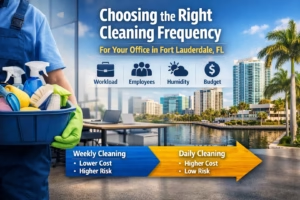
How to Choose the Right Service Frequency for Your Office
Frequency is where most office managers either overspend or underdeliver. The right cadence depends on three variables: number of employees, type of business, and client-facing exposure. Getting this wrong produces either wasted budget or visible neglect, and both undermine the cleaning program.
Frequency by office type and headcount
The table below maps standard recommendations based on observed patterns across professional offices in Broward County. Use it as a baseline, then adjust based on specific operational needs.
| Office Type | Headcount | Recommended Frequency | Reasoning |
| Small professional office | Under 15 | 1x to 2x weekly | Low traffic, controlled environment, minimal restroom load |
| Mid-size corporate office | 15 to 50 | 2x to 3x weekly | Moderate traffic, daily kitchen and restroom usage |
| Client-facing office (law, finance, consulting) | 15 to 50 | 3x to 5x weekly | Visible cleanliness is a credibility factor |
| Medical or dental office | Any size | Daily, with sanitization protocols | Compliance, infection control, patient perception |
| Large corporate office | 50 to 200 | 5x weekly, daily restroom service | High traffic, multiple zones, restroom turnover |
| Enterprise headquarters | 200+ | Daily, daytime porter optional | Continuous operation, visible upkeep throughout day |
| Coworking or multi-tenant | Variable | Daily, with daytime support | High turnover, shared spaces, brand impression |
The frequency decision should match the operational reality, not the budget. Underclean an office and the cost shows up in employee complaints, client perception, and HR conversations. Overclean an office and the cost shows up in the invoice without operational return.
Task frequency within a single contract
A common mistake is treating frequency as a single number applied to everything. In reality, a professional cleaning contract layers different frequencies for different task categories.
- Daily tasks — trash removal, restroom sanitization, kitchen wipe-down, high-touch surface disinfection, lobby and entrance cleaning
- Weekly tasks — vacuuming of all carpeted areas, mopping of hard floors, dusting of horizontal surfaces, full conference room reset
- Biweekly tasks — interior glass cleaning, baseboards, vents and air return covers, detailed restroom deep clean
- Monthly tasks — carpet edge detailing, high dusting, refrigerator interior, microwave deep clean, full kitchen appliance cleaning
- Quarterly tasks — carpet extraction, hard floor polishing or recoating, full window cleaning (interior), upholstery cleaning
- Annual or biannual tasks — exterior window cleaning, full carpet shampoo, deep restroom restoration, air duct surface cleaning
A vendor that layers frequencies correctly delivers consistent visible quality while controlling cost. A vendor that promises everything daily either overcharges or underdelivers, because daily execution of monthly tasks is operationally impossible at scale.
A Practical Example: Selecting the Right Vendor for Four Common Office Types
Theory is useful, but the selection process becomes clearer with specific examples. The following four scenarios reflect the most common office environments in Fort Lauderdale and the operational logic behind matching them with the right vendor profile.
Example 1: Mid-size law firm in Las Olas
Profile: 28 attorneys and staff, 6,800 square feet, client-facing reception, three conference rooms, full kitchen, restricted-access file rooms.
Operational priorities: confidentiality, after-hours access, polished client-facing areas, document security.
Recommended frequency: 3x weekly, after-hours, with daily restroom and kitchen touch-up if foot traffic justifies.
Vendor profile required: bonded staff, documented background checks, written confidentiality protocols, signed NDA option, key-holding capability with alarm code management, recurring same-crew rotation.
Pricing expectation: $1,800 to $2,800 per month for fully-staffed flat monthly contract with consumables included.
The decision driver here is trust and discretion. A vendor that cannot document staff vetting or refuses to sign an NDA is disqualified before pricing matters.
Example 2: Medical office near Coral Ridge
Profile: specialist practice, 4,200 square feet, 6 exam rooms, reception, lab area, staff kitchen, two restrooms.
Operational priorities: infection control, EPA-registered disinfectants, compliance documentation, daily sanitization of high-touch surfaces.
Recommended frequency: daily after-hours, with documented disinfection protocols and color-coded microfiber systems to prevent cross-contamination.
Vendor profile required: experience with medical environments, training in bloodborne pathogen protocols, hospital-grade disinfectants on the EPA List N, documented checklist per exam room, OSHA compliance awareness.
Pricing expectation: $2,500 to $4,500 per month depending on disinfection scope and consumables.
The decision driver here is compliance. A general office cleaner without medical experience is the wrong fit, regardless of price.
Example 3: Corporate office in Downtown Fort Lauderdale
Profile: regional headquarters, 14,000 square feet, 85 employees, two floors, executive suite, large kitchen, four restrooms, server room (excluded from cleaning).
Operational priorities: consistent visible quality, restroom upkeep throughout day, professional appearance for visiting executives and clients.
Recommended frequency: 5x weekly after-hours, plus daytime porter for restrooms and kitchen between 11am and 2pm.
Vendor profile required: capacity to staff multiple crew members simultaneously, supervisor on site during cleaning hours, quality assurance walkthroughs every two weeks, monthly performance reporting.
Pricing expectation: $4,500 to $7,200 per month including daytime porter coverage.
The decision driver here is scale and accountability. A small vendor without supervision infrastructure will struggle to maintain consistency across a large operation.
Example 4: Managed coworking or shared office space
Profile: 9,500 square feet, 60+ members rotating daily, shared kitchen, phone booths, meeting rooms, open lounge.
Operational priorities: continuous cleanliness throughout the day, brand presentation, rapid restock of consumables, flexible response to event setups.
Recommended frequency: daily after-hours, plus daytime attendant 4 to 8 hours per day depending on member volume.
Vendor profile required: flexible staffing, ability to handle event reset, consumables managed proactively, communication channel integrated with facility management software.
Pricing expectation: $5,000 to $9,000 per month depending on daytime coverage hours.
The decision driver here is responsiveness. The cleaning operation is part of the member experience, so the vendor must operate as an extension of the facility team rather than as an external service provider.
How to Structure the Contract So It Actually Protects You
A signed contract is only useful if it defines what happens when something goes wrong. Most cleaning contracts are written to protect the vendor, not the client. A well-structured contract reverses that balance and creates clear accountability mechanisms.
The clauses below should appear in any commercial cleaning contract before signing.
- Detailed scope of work attached as an appendix, with frequency and task definitions
- Service-level agreement (SLA) defining response time for issues and resolution time for quality complaints
- Quality assurance schedule specifying inspection frequency and reporting format
- Pricing lock period of at least 12 months with defined adjustment terms
- Cancellation clause with 30 to 60 day notice and no early termination penalty after the initial term
- Substitution policy governing what happens when the regular crew is unavailable
- Insurance documentation requirements with annual renewal verification
- Confidentiality and non-disclosure terms if relevant to your industry
- Data and document handling protocols for offices with sensitive materials
- Holiday and closure schedule defining service expectations during business closures
- Dispute resolution process with defined escalation steps before legal action
A vendor that resists any of these clauses is signaling future inflexibility. A vendor that proactively offers them is operating at a professional standard appropriate for a long-term commercial contract.
For a deeper view of how local providers structure operational agreements, the standards used by trusted office cleaning services in Fort Lauderdale reflect the contract architecture described above and serve as a useful reference point when comparing vendor proposals.
Why Hiring a Local Office Cleaning Company in Fort Lauderdale Outperforms National Chains
The decision between a local provider and a national franchise is not about brand recognition. It is about response time, accountability structure, and crew stability. National chains operate on standardized scripts and rotating subcontractor pools. Local providers operate on relationships, neighborhood familiarity, and direct ownership accountability.
For an office in Fort Lauderdale, the operational advantages of a local office cleaning company in Fort Lauderdale, FL compound over the lifetime of the contract. The vendor knows the building managers, understands after-hours access protocols in Downtown towers, navigates traffic patterns between Las Olas and Coral Ridge during cleaning shifts, and can respond to an urgent request within hours rather than days.
Principal advantages of choosing a local provider
The advantages below are not marketing claims. They are operational realities that experienced facilities managers measure in every renewal decision.
- Faster response time — a local crew dispatched from within Broward County reaches your office in 30 to 60 minutes for urgent issues, compared to 24 to 72 hours from a national chain routing through a call center.
- Direct ownership accountability — when something goes wrong, you reach the owner or operations manager directly, not a regional escalation queue.
- Crew stability — local providers retain staff longer because they staff fewer accounts at higher quality, which means the same crew cleans your office month after month.
- Neighborhood knowledge — familiarity with building access protocols in Downtown, Las Olas, Coral Ridge, Victoria Park, and Harbor Beach removes operational friction from day one.
- Flexibility on scope changes — local providers adjust frequency, add tasks, or accommodate special events without rebidding the contract.
- Local references that you can verify — a local provider can connect you with active clients in the same neighborhood, often in similar industries.
- Investment in long-term reputation — local providers depend on word-of-mouth within the Fort Lauderdale business community, which creates structural incentives for consistent quality.
Local provider versus national chain comparison
The table below summarizes the operational differences office managers observe after six months of service under each model.
| Criteria | Local Provider | National Chain |
| Response time for urgent issues | 30 to 60 minutes | 24 to 72 hours |
| Point of contact | Owner or operations manager | Regional call center |
| Crew stability | Same team for months or years | Frequent rotation, subcontractor pools |
| Scope adjustment | Handled directly, often same week | Requires contract amendment |
| Local knowledge | Neighborhood-level familiarity | Generic standardization |
| Pricing flexibility | Negotiable based on relationship | Rigid corporate pricing |
| Quality consistency | High when ownership is engaged | Variable, depends on local franchisee |
| Cultural fit with local business community | Strong, often referred by peers | Limited, transactional |
A national chain wins on brand recognition and standardized reporting. A local provider wins on every operational metric that affects daily office life. For most professional offices in Fort Lauderdale, the operational metrics matter more than the brand.
Advantages versus disadvantages of each model
Both models have legitimate strengths, and the right choice depends on the specific operational profile of your office.
Local provider advantages: faster response, direct accountability, crew stability, neighborhood familiarity, flexible scope, relationship-driven service, lower bureaucratic overhead.
Local provider disadvantages: may lack capacity for very large multi-site contracts, reporting infrastructure may be less formalized, technology stack may be simpler.
National chain advantages: capacity for multi-city operations, standardized reporting, brand recognition for procurement audits, technology platforms for service tracking.
National chain disadvantages: slower response, indirect accountability, crew rotation, generic execution, rigid pricing, distance from ownership decision-making.
For a single-site office in Fort Lauderdale, the local provider model delivers superior operational outcomes in nearly every measurable dimension.
Frequently Asked Questions About Choosing an Office Cleaning Company in Fort Lauderdale, FL
The questions below reflect the most common concerns office managers raise during vendor evaluation. Each answer is built to resolve the question on its own, without requiring context from another section.
- How much does office cleaning cost in Fort Lauderdale per month?
Office cleaning in Fort Lauderdale typically ranges from $250 per month for small offices under 2,500 square feet with weekly service, to over $8,000 per month for enterprise offices with daily service. Most mid-size offices between 5,000 and 10,000 square feet pay between $1,500 and $3,200 per month for three times weekly service. Pricing varies based on frequency, square footage, building access, consumables included, and specialty requirements such as medical-grade disinfection. - How often should an office be professionally cleaned?
The recommended frequency depends on headcount, foot traffic, and client-facing exposure. Small offices under 15 employees usually require one or two visits per week. Mid-size offices with 15 to 50 employees benefit from two or three visits per week. Client-facing offices and larger corporate environments typically require five visits per week, with daily restroom and kitchen attention. Medical offices require daily service with documented disinfection protocols regardless of size. - What should be included in an office cleaning checklist?
A complete office cleaning checklist includes daily tasks such as trash removal, restroom sanitization, kitchen cleaning, high-touch surface disinfection, and lobby maintenance. Weekly tasks cover vacuuming, mopping, dusting, and conference room resets. Biweekly tasks include interior glass cleaning and baseboards. Monthly tasks include high dusting, refrigerator interior, and detailed appliance cleaning. Quarterly tasks include carpet extraction and hard floor polishing. The exact checklist should be documented in the contract scope of work. - What is the difference between janitorial service and commercial cleaning?
Janitorial service refers to routine, recurring maintenance tasks performed on a daily or weekly basis, such as trash removal, restroom cleaning, and surface wiping. Commercial cleaning is the broader category that includes janitorial service plus periodic deep cleaning tasks such as carpet extraction, floor polishing, and window cleaning. A professional vendor delivers both, layered into a single contract with different frequencies for different task categories. - Do office cleaning companies bring their own supplies and equipment?
Reputable office cleaning companies provide all equipment and standard cleaning supplies as part of the monthly contract. This includes vacuums, mops, microfiber systems, commercial disinfectants, and floor care equipment. Consumables such as toilet paper, hand soap, paper towels, and trash liners are sometimes included and sometimes billed separately, depending on the contract structure. The arrangement should be clearly defined in the scope of work before signing. - What insurance should an office cleaning company carry?
A legitimate office cleaning company in Fort Lauderdale should carry general liability insurance with a minimum of $1 million per occurrence, workers’ compensation coverage as required by Florida law, and janitorial bonding to protect against employee theft. Certificates of insurance should be provided within 24 hours of request, and the client should be listed as a certificate holder for the duration of the contract. - Should office cleaning be done during business hours or after hours?
After-hours cleaning is the standard for most professional offices because it avoids disruption to employees and clients. Daytime porter service is added on top of after-hours cleaning when continuous upkeep is required, typically for restrooms, kitchens, and lobby areas in high-traffic environments. Coworking spaces, medical offices, and large corporate offices often combine both models to maintain visible cleanliness throughout the operating day. - How do I know if a cleaning company is reliable?
Reliability is measured by documented evidence, not promises. The strongest indicators are written scope of work, insurance and bonding documentation, W2 employee staffing, defined point of contact, scheduled quality assurance walkthroughs, and references from active commercial clients with contracts longer than 12 months. A vendor that cannot provide these documents during the sales process is unlikely to deliver them during service. - What is a service-level agreement for office cleaning?
A service-level agreement, or SLA, is a written commitment defining response times and resolution standards for quality issues. A typical SLA specifies that the vendor will acknowledge complaints within 24 hours, schedule a corrective visit within 48 hours, and complete remediation within 72 hours. The SLA also defines the escalation path when standard resolution fails. Without an SLA, service quality complaints become open-ended negotiations. - Can I switch office cleaning companies mid-contract?
Most commercial cleaning contracts include a cancellation clause requiring 30 to 60 days written notice. Some contracts include early termination fees during the initial term, typically the first 6 to 12 months. After the initial term, contracts usually convert to month-to-month with the same notice requirement. Reviewing the cancellation clause before signing is essential, because exit conditions become important when service quality declines. - What questions should I ask before hiring an office cleaning company?
The most useful questions during vendor evaluation cover staffing model, insurance coverage, quality assurance process, scope documentation, references, response time, and contract structure. Specific examples include: are your staff W2 employees or 1099 contractors, can you provide certificates of insurance and bonding within 24 hours, what is your quality assurance process, can you provide three references with contracts older than 12 months, and what is your defined response time for service issues. - How long should I wait before evaluating a new cleaning vendor?
The first 30 days are the onboarding window, where minor issues are expected and adjustments are normal. The 60-day mark is when consistency should be visible across every visit. The 90-day mark is the formal evaluation point, where the vendor either demonstrates that the contract is solving the cleaning problem permanently or signals that another vendor search will be necessary. Quarterly reviews after the initial period maintain accountability throughout the contract lifetime. - Are green cleaning products required in Fort Lauderdale offices?
Green cleaning products are not legally required for most commercial offices in Fort Lauderdale, but they are increasingly requested by tenants in LEED-certified buildings, environmentally conscious organizations, and offices with employee sensitivity concerns. Green-certified products carry certifications such as Green Seal, EcoLogo, or EPA Safer Choice. A professional vendor offers green options at standard pricing or with a defined surcharge depending on product cost. - What is the typical contract length for office cleaning services?
Most commercial cleaning contracts run for an initial term of 12 months, automatically renewing on a month-to-month basis after the initial term. Some larger contracts run for 24 or 36 months with built-in price adjustments. The contract length should align with the operational stability of your office and the level of customization required in the cleaning program. Shorter terms offer flexibility, longer terms typically secure better pricing. - How do I handle complaints with an office cleaning company?
Complaints should be submitted in writing to the defined point of contact, with specific details about the issue, location, and date. A professional vendor acknowledges the complaint within 24 hours, investigates the cause, schedules corrective action within 48 hours, and reports back with a resolution summary. Repeated complaints on the same issue indicate a structural problem and should trigger a formal review meeting under the SLA escalation process.
Final Considerations on Selecting the Right Office Cleaning Partner
Choosing the right office cleaning company in Fort Lauderdale is not a procurement task. It is an operational decision that affects employee experience, client perception, and the daily workload of the facilities team. The vendors that deliver long-term value share a consistent profile: documented operations, stable staffing, written accountability mechanisms, local presence, and ownership-level responsiveness.
The selection framework described throughout this guide reduces the decision to a structured evaluation rather than a price comparison. Verify insurance and bonding before anything else. Demand a written scope of work with task-by-task frequency definitions. Audit references from active commercial clients with contracts older than 12 months. Test response time during the sales process. Match the frequency model to your office type and headcount. Choose a pricing structure that prevents budget drift. Sign a contract that includes service-level agreements, quality assurance schedules, and clear cancellation terms.
When all of these elements align, cleaning stops being a recurring topic in your operations meetings. The office is consistently clean, the team is consistently the same, the communication channel is consistently responsive, and the invoice is consistently predictable. That is the operational outcome a professional cleaning program is supposed to deliver, and it is the standard that defines the difference between a vendor that solves the problem and a vendor that becomes the problem.
The right partner treats your office as a recurring operational responsibility, documents every commitment, and operates with the local accountability that only a Fort Lauderdale-based provider can deliver. Build the evaluation around these principles, and the vendor selection becomes a decision that holds for years rather than a recurring cycle of rebidding every six months.