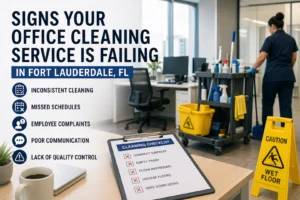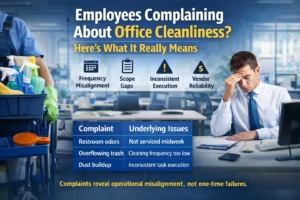
Choosing the right cleaning frequency keeps your office professional, your staff satisfied, and your budget under control. Here is what actually matters for Fort Lauderdale offices.

The Direct Answer: Which Cleaning Schedule Fits Your Fort Lauderdale Office?
If you manage a commercial office in Fort Lauderdale and you need to decide between daily office cleaning and weekly office cleaning, the answer depends on three things: how many people use the space every day, whether clients visit your office regularly, and how fast your restrooms and kitchen lose their standard between service visits. For offices with more than 25 employees on site, shared restrooms, a functioning break room, and any kind of client facing activity, daily cleaning is almost always the right call. For smaller teams under 15 people, especially hybrid setups where the office sits empty two or three days a week, weekly cleaning maintains a solid baseline without overspending.
Fort Lauderdale adds a layer that most cleaning guides written for national audiences miss entirely. Humidity in Broward County averages above 73 percent for most of the year, which means mold, mildew, and bacteria develop faster on shared surfaces than they would in Phoenix or Denver. Sand and fine debris track in through every entrance, especially along the Federal Highway corridor, Las Olas, Cypress Creek, and the Downtown business district. These conditions compress the window between “clean office” and “visible decline,” and that compression changes the math on frequency for every office in the area.
The practical takeaway is straightforward: if your current office cleaning schedule leaves you fielding complaints by midweek, the frequency needs to change. If your office holds its standard between visits and nobody notices the cleaning at all, you are on the right schedule. Office Cleaning Services in Fort Lauderdale, FL that offer a proper walkthrough before quoting will help you confirm which model fits, because the answer should come from observed conditions, not assumptions.
Why Cleaning Frequency Is the Decision That Shapes Everything Else
Most office managers treat cleaning frequency as a budget line item. That framing misses the point. Cleaning frequency is the operational variable that determines whether your workspace stays consistently professional or drifts into a cycle of complaints, corrections, and vendor frustration. When the frequency matches the operation, the cleaning company becomes invisible, which is exactly what a well run office needs. When the frequency falls short, the office manager absorbs every complaint personally, spends time coordinating fixes, and eventually faces a conversation with leadership about why the space looks the way it does.
The cost of getting frequency wrong is rarely the cleaning contract itself. The real cost shows up in the hours the facilities team spends managing issues that a correct schedule would have prevented.
Three factors specific to Fort Lauderdale amplify this dynamic. First, the consistent humidity accelerates bacterial growth on high touch surfaces like door handles, elevator buttons, shared printers, and restroom fixtures. A surface that stays acceptable for five days in a dry climate may need attention every two days in South Florida. Second, salt air corrodes metal fixtures, clouds glass partitions, and dulls exterior facing windows faster than offices in landlocked cities experience. Third, the volume of commercial activity concentrated between I 95 and the coast produces foot traffic patterns that carry outdoor debris into lobbies, hallways, and reception areas at a pace that surprises office managers who have relocated from other regions.
These are operational realities, and they change the cleaning frequency equation in measurable ways.
What Exactly Is Daily Office Cleaning and What Does the Service Include?
Daily office cleaning is a recurring service performed every business day, usually after hours, that maintains a continuous hygiene and appearance standard across the entire office footprint. The goal of a daily program is prevention, not restoration. Each visit resets the space to a baseline that prevents accumulation from reaching a point where anyone, whether staff, clients, or visitors, notices a decline.
A standard daily cleaning scope of work for a commercial office in Fort Lauderdale covers these functional zones:
- Restroom sanitization including toilets, urinals, sinks, mirrors, partitions, dispensers, and floor mopping with disinfectant
- Kitchen and break room reset covering countertops, sink basin, microwave exterior, refrigerator handle, table surfaces, and full trash removal
- High touch surface disinfection on door handles, light switches, shared equipment panels, elevator call buttons, and conference room tables
- Trash and recycling removal from every workstation, common area, and exterior bin
- Vacuuming of high traffic carpeted zones including the reception area, main hallways, and pathways between workstation clusters
- Hard floor maintenance in lobby and entryway zones, which matters considerably in Fort Lauderdale where sand, moisture, and tracked debris accumulate daily
- Visual inspection and spot correction of reception, glass partitions, and any client facing space
Each of these tasks is calibrated to prevent the kind of overnight or multiday accumulation that generates internal complaints. The cleaning team follows a cleaning checklist built around the specific layout of the office, and adjustments happen based on seasonal patterns, occupancy shifts, or specific requests from the office manager.
Daily cleaning does not mean a deep clean every visit. Deep cleaning tasks like baseboard detailing, vent surface wiping, blind dusting, and carpet extraction operate on a separate monthly or quarterly cycle. What daily service provides is the operational continuity that keeps the office at a consistent cleaning standard without requiring the office manager to think about it.
Who Benefits Most from Daily Office Cleaning in Fort Lauderdale?
The offices that gain the most from a daily cleaning schedule share a common profile: continuous occupancy, shared infrastructure that gets heavy use, client facing activity, and in many cases, industry requirements that demand a visible standard of hygiene and professionalism.
In Fort Lauderdale specifically, the types of offices where daily cleaning produces the clearest return include:
- Law firms along Las Olas Boulevard and Downtown that host client meetings, depositions, and document reviews throughout the week
- Accounting and financial advisory offices in the Cypress Creek corridor, where client facing conference rooms need to be presentable without advance scheduling of a cleaning visit
- Medical and dental administrative offices that operate under health compliance expectations even when the space is administrative rather than clinical
- Insurance agencies with walk in client traffic and shared waiting areas
- Corporate offices with 30 or more employees on site generating continuous restroom, kitchen, and common area usage
- Call centers and operations centers running shift based staffing where the space never fully empties during business hours
What these offices share is a low tolerance for visible decline. A dirty office environment in a law firm before a client meeting, or a neglected restroom in a financial advisory practice before an audit, creates a reputational cost that exceeds the annual cleaning contract by orders of magnitude.
The decision to choose daily cleaning is not about luxury. It is about matching the cleaning frequency to the actual operational demands of the office, so the office manager never has to field a complaint about something that a correct schedule would have prevented.
What Exactly Is Weekly Office Cleaning and What Does the Service Cover?
Weekly office cleaning is a scheduled service performed once per week on a fixed day, designed to reset the entire office to a professional standard in a single visit. Because the cleaning team absorbs a full week of accumulation in one session, the scope of a weekly visit runs broader and deeper than what a daily visit covers. Floors get full attention. Dusting reaches shelving, baseboards, and electronics. Restrooms receive a thorough detail rather than a maintenance pass.
The structure works well when the office generates limited accumulation between visits, meaning fewer people on site, lower restroom and kitchen usage, and minimal client facing activity during the week.
A standard weekly cleaning scope of work for a Fort Lauderdale commercial office typically includes:
- Full restroom deep cleaning with detailed attention to grout lines, fixture polishing, mirror detailing, partition wipe down, and thorough floor sanitization
- Complete kitchen and break room reset including appliance exteriors, cabinet fronts, sink deep clean, counter sanitization, and full trash removal with bin wipe down
- Comprehensive dusting across all desks, shelving units, baseboards, window blinds, monitor screens, and electronics
- Full carpet vacuuming covering every zone of the office, including under desks, corners, and low traffic areas that daily programs often skip
- Hard floor mopping across the entire office footprint, from the lobby through internal corridors
- Interior glass cleaning on partitions, conference room walls, front entry doors, and sidelights
- Trash and recycling removal from all stations and common areas, with bin sanitization
- Conference room full reset including table polish, chair alignment, whiteboard cleaning, and AV equipment surface wipe down
After each weekly visit, the office should present a “Monday morning standard” that holds through the first few days. Whether that standard holds through Friday depends entirely on how many people use the space and how intensively the shared infrastructure gets used between visits.
The key distinction between weekly and daily service is the accumulation curve. Daily cleaning prevents accumulation from building. Weekly cleaning allows accumulation to build and then resets it. For the right office profile, both approaches produce the same outcome: a workspace that maintains a consistent cleaning standard without generating complaints.
Who Should Choose Weekly Office Cleaning in Fort Lauderdale?
Weekly cleaning fits a specific operational profile, and understanding that profile prevents the most common mistake office managers make when selecting a cleaning schedule: choosing a frequency based on budget instead of actual usage patterns.
The offices where weekly service consistently delivers results share these characteristics:
- Small professional offices with fewer than 15 employees on site during any given day
- Hybrid and remote first teams where physical occupancy averages two or three days per week, leaving the space lightly used the rest of the time
- Administrative back offices that support a larger operation but receive no client visits and minimal foot traffic
- Satellite and branch offices with limited daily activity and controlled building access
- Real estate brokerages and consulting firms where most work happens off site and the office serves primarily as a coordination space
- Early stage businesses operating in leased suites without dedicated reception or shared common areas
In Fort Lauderdale, weekly cleaning also fits offices located in managed business parks along Commercial Boulevard, Powerline Road, and parts of West Broward where building management provides common area maintenance separately. When the landlord handles lobby, elevator, and restroom cleaning for shared floors, the tenant’s cleaning scope narrows to the private suite, and weekly service often covers that scope comfortably.
The test is simple and practical. If the office holds its visual and hygiene standard from Monday through Friday without complaints surfacing by Wednesday or Thursday, the weekly schedule fits. If complaints appear consistently before the next scheduled visit, the office has outgrown the weekly model and needs to evaluate either a hybrid cleaning schedule or a move to daily service.
How Do Daily and Weekly Office Cleaning Compare Side by Side?
The most useful way to evaluate the office cleaning frequency comparison between daily and weekly service is across the operational, financial, and risk dimensions that actually drive the decision for an office manager. The table below presents that comparison without abstraction.
| Factor | Daily Cleaning | Weekly Cleaning |
| Visit frequency | 5 visits per week (Monday through Friday) | 1 visit per week on a fixed day |
| Scope per visit | Maintenance reset focused on prevention | Deep reset absorbing full week of accumulation |
| Best fit by occupancy | 25 or more employees on site daily | Fewer than 15 employees on site daily |
| Restroom standard | Sanitized and restocked every business day | Full deep clean once per week |
| Kitchen and break room | Daily surface reset, trash removal, and wipe down | Weekly deep clean of all surfaces and appliances |
| Client facing readiness | Continuous, any day of the week | Strongest on the day of service, declining through the week |
| Compliance and audit fit | High, suitable for medical admin, legal, and financial offices | Low to moderate, adequate for general administrative use |
| Complaint risk | Very low when matched to the right operation | Moderate to high when applied to offices that need more frequency |
| Typical monthly cost in Fort Lauderdale | $1,800 to $4,500 depending on square footage | $400 to $1,200 depending on square footage |
| Recovery time after a missed visit or issue | Same day or next day correction possible | Up to 6 business days before the next scheduled visit |
| Operational predictability for the office manager | High, minimal management overhead | Moderate, may require midweek spot coordination |
| Floor and surface wear over 12 months | Lower, due to consistent debris removal | Higher in Fort Lauderdale due to extended sand and humidity exposure |
This table captures the structural differences, but the real insight sits behind the numbers. A weekly contract priced at $800 per month that generates four internal complaints per week costs more in management time, staff frustration, and reputational risk than a daily contract at $3,000 per month that generates zero. The financial comparison only tells the full story when you factor in the operational cost of the wrong frequency.
That operational cost is where most office managers underestimate the impact of their decision, because it does not appear on an invoice. It shows up in the hours spent fielding restroom complaints, coordinating emergency cleanings before a client visit, and explaining to leadership why the office does not reflect the company’s standard.
What Are the Main Advantages of Daily Office Cleaning?
The advantages of daily office cleaning compound over the duration of the contract, because the model is built on prevention rather than correction. Each benefit listed below connects directly to the operational priorities that drive decision making for an office manager or facilities manager responsible for the workspace.
- Consistent visual and hygiene standard every business day. The office looks and feels the same on Monday as it does on Friday, which eliminates the midweek decline that weekly schedules produce in higher occupancy spaces.
- Dramatically lower internal complaint volume. When restrooms are sanitized daily, kitchens are reset every evening, and trash never sits overnight, the most common sources of employee complaints disappear before anyone notices them.
- Stronger compliance posture for regulated industries. Law offices, financial advisory firms, medical administrative spaces, and insurance agencies in Fort Lauderdale operate under expectations, both formal and informal, that the physical environment reflects the professionalism of the service. Daily cleaning meets that standard without requiring special preparation before audits or client visits.
- Continuous client facing readiness. An unannounced visit from a prospective client, a last minute meeting in the conference room, or a partner walkthrough never catches the office in a state of visible neglect when the space is cleaned every day.
- Faster issue resolution and better communication with the cleaning provider. Because the professional cleaning team is on site daily, specific requests, adjustments, and seasonal needs get addressed within 24 hours instead of waiting for the next weekly visit.
- Reduced long term wear on flooring, carpets, and surfaces. This advantage matters especially in Fort Lauderdale, where sand tracked in through entryways acts as an abrasive on both carpet fibers and hard floor finishes. Daily vacuuming and mopping removes that debris before it grinds into surfaces over multiple days.
- Predictable staff experience that supports employee retention. Workplace condition surveys consistently show that employees who work in well maintained offices report higher satisfaction and lower friction with facilities. When the restroom is always clean, the kitchen never smells, and the workspace feels professionally maintained, those conditions become invisible, which is exactly the point.
These advantages do not exist in isolation. They compound. An office running daily cleaning for twelve months typically needs fewer emergency deep cleans, fewer flooring restorations, and fewer vendor switches than an office on weekly service over the same period. The upfront cost is higher, but the total cost of ownership across a year often narrows significantly once you account for avoided corrections and management overhead.
What Are the Main Advantages of Weekly Office Cleaning?
Weekly office cleaning carries a different set of advantages, and they are genuine advantages for the offices that fit the profile. The mistake is not choosing weekly cleaning. The mistake is applying weekly cleaning to an operation that needs daily service. When the match is right, weekly cleaning delivers strong value.
- Significantly lower monthly cost. Weekly service runs three to five times less than daily service on the same square footage, which makes it the appropriate choice for offices where the budget needs to stay lean and the operational demands support a single visit per week.
- Simpler vendor coordination and scheduling. One visit per week on a fixed day requires less coordination between the office manager, the building, and the cleaning provider. For offices with limited after hours access or complex building security protocols, this simplicity matters.
- Deeper scope per visit. Because the cleaning team has more time during each session, the weekly visit typically includes tasks that daily programs handle on a monthly cycle, like detailed dusting of blinds, baseboard wiping, and full surface attention in low traffic zones.
- Minimal disruption to office operations. For offices that cannot provide after hours access five days a week, or where building management restricts vendor entry, a single weekly visit concentrates the disruption into one evening or weekend session.
- Adequate hygiene baseline for low occupancy spaces. When the office has fewer than 15 people on site and the shared infrastructure sees light use, the accumulation curve between visits stays below the threshold where anyone notices a decline. In this scenario, weekly cleaning produces the same practical outcome as daily service for a fraction of the cost.
- Easier budget approval for smaller organizations. Small businesses, startups, and satellite offices often lack a dedicated facilities budget. Weekly cleaning fits within general operating expenses without requiring a separate line item approval from leadership.
- Sufficient for offices with controlled access and limited shared zones. When the office consists primarily of individual offices or small clusters without a shared kitchen, high traffic restroom, or public reception area, weekly cleaning covers the functional need.
Weekly cleaning is a complete, professional service. It becomes a problem only when it is applied to an office that generates more accumulation than one visit per week can absorb. The discipline for the office manager is honest assessment of actual usage patterns, not aspirational estimates of how the space “should” perform between visits.
Advantages and Disadvantages: A Direct Comparison
Understanding the strengths of each model is only half the picture. Every cleaning frequency carries trade offs, and the office manager who recognizes those trade offs before signing a contract avoids the cycle of frustration, complaints, and vendor switching that consumes time and credibility.
Advantages of Daily Cleaning at a Glance
| Advantage | Why It Matters Operationally |
| Consistent standard every day | No midweek decline, no surprises before client visits |
| Near zero complaint volume | Office manager’s time stays focused on priorities, not cleaning issues |
| Compliance ready at all times | Audits, inspections, and partner visits require no advance preparation |
| Lower surface and flooring wear | Daily debris removal prevents abrasive damage, especially with Fort Lauderdale sand exposure |
| Faster communication with vendor | On site presence every day allows same day adjustments |
Advantages of Weekly Cleaning at a Glance
| Advantage | Why It Matters Operationally |
| Three to five times lower monthly cost | Budget stays lean for offices with light usage |
| Deeper scope per visit | More thorough attention to detail in each session |
| Minimal coordination required | One fixed visit per week simplifies scheduling |
| Adequate for low occupancy offices | Hybrid teams and small offices maintain standard comfortably |
| Easier budget approval | Fits within general operating expenses without special approval |
Disadvantages of Daily Cleaning
- Higher monthly investment that may exceed the operational need for offices with fewer than 15 employees, creating an unnecessary expense without proportional benefit
- Requires consistent after hours building access five days per week, which may need coordination with property management and security, especially in managed buildings along the Fort Lauderdale corridor
- More complex scheduling if the office has variable closing times, seasonal hours, or restricted access windows during certain days
- Potential overcapacity when applied to a low occupancy, low traffic operation that simply does not generate enough accumulation to justify daily visits
These disadvantages are real, but they apply specifically to offices that do not match the daily cleaning profile. For the offices that do match, none of these trade offs outweigh the operational benefits.
Disadvantages of Weekly Cleaning
- Visible accumulation by midweek in offices with more than 20 employees, active kitchens, and shared restrooms, leading to the exact complaints the cleaning contract was supposed to prevent
- Higher complaint risk when the office operation exceeds the capacity of a weekly visit, which damages the office manager’s credibility with staff and leadership
- Limited recovery window if a cleaning issue occurs, since the next scheduled visit may be five or six business days away, leaving no mechanism for timely correction
- Insufficient for regulated or client facing industries that require continuous hygiene documentation or a constant visual standard
- Accelerated floor and surface wear in Fort Lauderdale due to extended exposure to tracked sand, humidity driven grime, and salt residue that sits on surfaces for up to a week between visits
The trade offs on both sides point to the same principle. The right frequency is the one that matches the actual operation. Choosing based on cost alone leads to underspending on offices that need daily service and overspending on offices that run fine on weekly visits. The comparison exists to help the office manager place their specific situation on the right side of the table.
When Should You Switch from Weekly to Daily Cleaning?
The decision to upgrade from weekly cleaning to daily cleaning rarely happens because of a single event. It happens because a pattern of small failures accumulates until the office manager recognizes that the current frequency no longer matches the reality of how the space operates. Recognizing those signals early saves months of frustration, avoids complaint escalations to leadership, and prevents the slow erosion of confidence that staff develop when the workspace consistently falls below the standard they expect.
The most reliable indicators that a weekly schedule has been outgrown include:
- Restroom complaints before the scheduled cleaning day. When employees report odor, depleted supplies, or visible grime in shared restrooms two or three days before the next visit, the accumulation curve has exceeded the frequency.
- Kitchen and break room complaints related to trash, surface residue, or odor. A break room used daily by more than 15 people generates enough waste, spills, and surface contamination to overwhelm a weekly reset within two or three business days.
- Visible dust accumulation on desks, shelving, and electronics midweek. In Fort Lauderdale, humidity causes airborne particulates to settle and adhere to surfaces faster than in drier climates, making this signal particularly common for offices running weekly service.
- Client or visitor comments about the appearance of reception, conference rooms, or common areas. When someone outside the organization notices, the standard has slipped past the point where internal familiarity hides it.
- Staff bringing personal cleaning supplies to work. Disinfectant wipes on desks, personal trash bags, and individual air fresheners are clear indicators that employees have stopped trusting the cleaning program to maintain their workspace.
- The office manager spending more than two hours per week coordinating cleaning related requests, complaints, or emergency corrections. At that point, the management overhead of maintaining a weekly schedule exceeds the cost difference between weekly and daily service.
- Leadership questioning the standard of the office before important meetings, client visits, or internal events. When cleaning becomes a topic in leadership conversations, the frequency has already fallen behind the operation.
When three or more of these signals appear consistently over a 60 to 90 day window, the operation has outgrown weekly service. The correct response is not to pressure the current vendor for better results on the same schedule. The correct response is to evaluate a hybrid cleaning model or move to daily office cleaning before the complaints formalize into a vendor review that consumes even more time and organizational attention.
The transition itself is straightforward with an established provider. Most commercial cleaning companies in Fort Lauderdale accommodate frequency upgrades within one to two weeks, adjusting staffing and scheduling without interrupting existing service. The conversation should happen before the frustration peaks, not after.
How Much Do Daily and Weekly Office Cleaning Cost in Fort Lauderdale?
Office cleaning pricing in Fort Lauderdale varies based on square footage, scope of work, cleaning frequency, and the specific zones and surfaces included in the contract. The ranges below represent current market conditions for Professional Cleaning Services in Fort Lauderdale, FL and reflect standard commercial office scopes without specialty add ons like floor stripping, post construction cleanup, or exterior window washing.
| Office Size | Weekly Cleaning (Monthly Cost) | Daily Cleaning (Monthly Cost) | Hybrid Model (Monthly Cost) |
| Up to 1,500 sq ft | $320 to $520 | $1,400 to $2,200 | $700 to $1,100 |
| 1,500 to 3,000 sq ft | $480 to $780 | $1,800 to $3,000 | $950 to $1,500 |
| 3,000 to 5,000 sq ft | $720 to $1,100 | $2,600 to $4,200 | $1,400 to $2,200 |
| 5,000 to 8,000 sq ft | $1,000 to $1,500 | $3,400 to $5,200 | $1,800 to $2,800 |
| 8,000 to 12,000 sq ft | $1,400 to $2,100 | $4,800 to $7,000 | $2,600 to $3,800 |
| 12,000 sq ft and above | Custom quote required | Custom quote required | Custom quote required |
What Factors Influence the Final Price?
The ranges above represent starting points, not fixed rates. Several variables move the final number within those ranges or beyond them.
Square footage is the baseline, but usable square footage matters more than total lease area. An office with 4,000 square feet of open floor plan cleans differently than 4,000 square feet divided into 20 individual offices with doors, each requiring separate attention.
Number and condition of restrooms directly affects labor time. A two restroom office costs less to maintain than a four restroom layout, and restrooms with older fixtures, grout, and ventilation systems require more intensive cleaning to maintain the same standard.
Kitchen and break room complexity scales with the number of appliances, counter space, and daily usage volume. An office with a single microwave and coffee maker requires far less reset time than a full kitchen with dishwasher, refrigerator, toaster oven, and communal dining tables.
Flooring type and condition matters because carpet requires vacuuming while hard floors require mopping, and many Fort Lauderdale offices have a mix of both. Older carpet in high traffic areas may need extraction cleaning on a quarterly cycle, which adds to the annual cost even if the monthly contract covers routine maintenance.
After hours access requirements can affect pricing if the building charges for extended HVAC operation, requires security escort for vendors, or limits cleaning windows to specific hours that reduce scheduling flexibility.
Specialty surfaces like natural stone lobbies, glass conference room walls, and stainless steel fixtures require specific products and techniques that standard cleaning scopes may not include by default.
The most accurate way to confirm what your office will actually cost is a walkthrough with the cleaning provider. Any established commercial cleaning company in Fort Lauderdale will conduct a site assessment at no charge and provide a written scope of work with clear pricing before asking for a commitment. Providers who quote over the phone without seeing the space are quoting from assumption, and assumption based pricing leads to scope disputes, service gaps, and contract frustration within the first 90 days.
A Real World Example: How One Fort Lauderdale Accounting Office Made the Decision
Consider a practical scenario that illustrates how the frequency decision plays out in a real Fort Lauderdale office environment. This example reflects a common profile among the professional offices that line the Cypress Creek and Commercial Boulevard corridors.
The office is a 4,200 square foot accounting firm with 28 employees on site during regular business hours. The layout includes two shared restrooms, a full kitchen used for lunch by most of the staff, a reception area that receives clients three days per week, two conference rooms, and an open floor plan with workstation clusters. The firm operates from 8 AM to 6 PM during normal months and extends to 8 PM during tax season from January through April.
What Happened on a Weekly Schedule
The firm started with weekly office cleaning at a monthly cost of approximately $880. For the first three weeks, the arrangement felt adequate. By the fourth week, a pattern emerged.
Restroom complaints surfaced by Wednesday afternoon. The kitchen developed a noticeable odor by Thursday. Dust accumulated visibly on conference room tables, and the office manager found herself wiping surfaces with paper towels before client meetings on Friday mornings. By the sixth week, a senior partner mentioned the condition of the reception area during a conversation about an upcoming client presentation.
The office manager estimated she was spending roughly four hours per week fielding complaints, coordinating spot corrections, and managing her own frustration with a schedule that clearly could not keep pace with the office’s actual usage.
What Changed with Daily Service
The firm transitioned to daily office cleaning at a monthly cost of approximately $3,200. The operational shift was immediate. Restrooms maintained a consistent standard every morning. The kitchen reset happened every evening. Conference rooms were presentation ready without advance coordination. The reception area looked professional on any given day, regardless of client schedule.
The Actual Math Behind the Decision
| Metric | Weekly Schedule | Daily Schedule |
| Monthly cleaning cost | $880 | $3,200 |
| Office manager hours spent on cleaning issues per month | 16 hours | Less than 1 hour |
| Internal complaints per month | 12 to 18 | 0 to 1 |
| Emergency cleaning requests per quarter | 3 to 5 | 0 |
| Client facing readiness | Required advance coordination | Continuous |
| Staff satisfaction with workspace | Declining by month two | Stable and positive |
The net financial difference is $2,320 per month. But the office manager recovered 15 hours per month of productive time, the complaint volume dropped to near zero, and the firm’s physical environment matched the professional standard that clients and partners expected. For a regulated, client facing operation in a competitive market like Fort Lauderdale, the daily schedule delivered a clear return that the monthly cost difference alone does not capture.
This example is not unusual. It reflects the reality that most professional offices with more than 20 employees, shared restrooms, active kitchens, and client facing operations discover within 60 to 90 days of starting weekly service. The frequency decision is ultimately an operational decision, and operational decisions should be evaluated on total impact, not line item cost alone.
What Questions Should You Ask Before Signing a Cleaning Contract?
The questions that separate a strong vendor selection from a regrettable one are operational, not promotional. Before signing any contract for Office Cleaning Services in Fort Lauderdale, FL, an office manager should confirm specific details that directly affect whether the service will actually perform as expected.
Scope and Documentation
- Is the scope of work documented in writing, listing every zone and every task included in each visit? A verbal scope or a vague one page summary creates room for misalignment between what the office manager expects and what the cleaning team delivers. The scope should be detailed enough that a new cleaning crew member could read it and execute the service correctly without verbal instruction.
- Are there tasks excluded from the standard scope that the office might need? Common exclusions include interior window cleaning above a certain height, carpet extraction, floor stripping and waxing, and exterior cleaning. Knowing what falls outside the base contract prevents surprise invoices.
Staffing and Trust
- Are all cleaning staff background checked and verified? For offices that contain sensitive documents, client files, financial records, or regulated information, this question is non negotiable. The vendor should provide documentation of their screening process on request.
- Is the cleaning company fully insured and bonded? General liability insurance and a surety bond protect the office in the event of damage, theft, or injury during service. Ask for certificate of insurance with your company listed as additionally insured.
- What is the staff assignment model? Some vendors assign the same team to your office consistently, which improves quality over time. Others rotate staff, which can create inconsistency. Knowing the model sets expectations correctly.
Quality and Communication
- What is the quality control process? A credible answer includes regular inspections, a feedback loop with the office manager, and a documented escalation procedure for issues. A vague answer like “we make sure everything is done right” is a red flag.
- What is the primary communication channel and expected response time for issues? Whether the vendor uses phone, email, a client portal, or a dedicated account manager, the response protocol should be clear and the turnaround should not exceed 24 hours for non emergency issues.
Scheduling and Access
- What are the exact days and time windows for each visit? The schedule should align with building access rules, HVAC operation hours, and the office’s own operational pattern. Ambiguity here leads to missed visits and after hours conflicts.
- What happens when a scheduled visit is missed? The contract should specify the make up policy, whether a missed visit results in a credit, a rescheduled visit, or no adjustment at all.
Contract Terms and Flexibility
- What is the minimum contract commitment, and what are the cancellation terms? Most Fort Lauderdale commercial cleaning contracts run month to month after an initial 90 day period. Contracts that lock in for 12 months without a performance exit clause should be evaluated carefully.
- Can the frequency be adjusted mid contract if the office’s needs change? Offices grow, shrink, and shift occupancy patterns. The contract should allow for scope and frequency adjustments with reasonable notice, typically 30 days.
- Are cleaning supplies and consumables included in the contract, or billed separately? Toilet paper, paper towels, hand soap, trash liners, and disinfectant are recurring expenses. Knowing whether they are bundled or separate affects the true monthly cost.
Every one of these questions has a right answer and a revealing wrong answer. Vendors who respond with specifics, documentation, and operational detail belong on the shortlist. Vendors who respond with generalities, deflection, or marketing language do not. The hiring process for a cleaning vendor follows the same logic as any B2B procurement: clarity, documentation, and accountability are the foundations of a contract that actually works.
How Does Fort Lauderdale’s Climate Change Office Cleaning Requirements?
Most office cleaning guides are written for a national audience and assume a moderate, temperate climate. Fort Lauderdale does not operate under those conditions. The subtropical environment in Broward County introduces specific variables that affect cleaning frequency, product selection, scope of work, and long term maintenance costs in ways that office managers relocating from northern or western states may not anticipate.
Humidity and Its Effect on Indoor Surfaces
Fort Lauderdale’s average annual humidity sits above 73 percent, with peaks above 85 percent during the summer months from June through September. Inside an office, even with functioning HVAC, that humidity creates conditions where mold, mildew, and bacteria develop on surfaces faster than in drier markets.
Restrooms are the most affected zone. Grout lines, caulking around fixtures, and the underside of sink counters become breeding environments for mold when moisture is not removed consistently. A restroom that might stay acceptable for five days between cleanings in Denver begins showing visible mildew within two or three days in Fort Lauderdale during peak humidity months.
Kitchens and break rooms follow a similar pattern. Moisture retention around sinks, on counter surfaces, and inside trash receptacles accelerates odor development and bacterial growth. The “Wednesday smell” that Fort Lauderdale office managers on weekly schedules often describe is a direct product of humidity acting on organic waste and surface moisture between visits.
Carpet and upholstered furniture absorb ambient moisture and trap allergens, dust mites, and biological particulates at higher concentrations than the same materials in arid climates. Offices with significant carpet coverage in Fort Lauderdale benefit from more frequent vacuuming with HEPA filtration and periodic extraction cleaning to prevent the accumulation from affecting indoor air quality.
Sand, Debris, and Coastal Exposure
Fort Lauderdale’s proximity to the coast and the general composition of local soil mean that fine sand and outdoor debris enter office buildings through every door, every day. Offices near the beach, along A1A, or within the Downtown and Las Olas districts experience this at higher volumes, but even offices further west along University Drive and the Sawgrass corridor deal with particulate tracking.
That debris acts as an abrasive. On carpet, it grinds into fibers and accelerates wear patterns in high traffic lanes. On hard floors, it scratches finishes and dulls polish. On lobby tile and stone, it creates a gritty residue that clients feel underfoot when they walk in. Daily vacuuming and mopping removes this debris before it causes damage. Weekly service allows it to sit for up to six days, compounding the abrasion with every step.
Salt Air and Metal Fixture Corrosion
Salt air from the Atlantic reaches most of eastern Broward County and affects building exteriors, interior fixtures near windows, and any metal surface exposed to air circulation. Over time, salt residue clouds glass, corrodes stainless steel fixtures, and dulls chrome hardware. Offices with large window surfaces, glass conference rooms, or metal accented reception desks need more frequent surface attention to maintain a professional appearance than the same fixtures would require in an inland city.
Rainy Season and Entryway Management
Fort Lauderdale’s rainy season runs from May through October, with afternoon thunderstorms occurring almost daily during peak months. Each storm event brings water, mud, and debris into office entryways, lobbies, and first floor corridors. Offices without adequate matting systems or entryway management protocols find that their lobbies become slip hazards and visual problems within hours of a storm.
After hours cleaning that includes entryway mopping, mat rotation, and floor treatment during rainy season is a Fort Lauderdale specific need that national cleaning guides do not address. For offices running daily service, this becomes part of the routine. For offices on weekly service, rainy season often triggers the midweek complaints that eventually drive a frequency upgrade.
HVAC and Vent Maintenance Interaction
Fort Lauderdale office HVAC systems run at high capacity for most of the year, circulating air through ductwork that collects dust, biological material, and moisture condensation. Vent covers, ceiling tiles near supply registers, and return air grilles accumulate visible dust faster than in temperate climates. While duct cleaning is a separate maintenance category, the cleaning program should include regular attention to visible vent surfaces, diffuser covers, and the areas immediately surrounding HVAC output points.
This climate context is not a sales pitch for more frequent cleaning. It is a factual description of the conditions that affect every commercial office in Broward County. An office manager making a cleaning frequency decision for a Fort Lauderdale location should factor these variables into the evaluation, because a schedule that worked perfectly in Charlotte or Chicago may underperform in South Florida without adjustment.
What Is a Hybrid Cleaning Schedule and When Does It Make Sense?
A hybrid cleaning schedule combines elements of daily and weekly service into a single program designed to match offices that fall between the two standard models. The structure typically pairs daily light maintenance on high use zones with weekly or biweekly deep cleaning across the full office footprint. This approach gives the office manager the operational consistency of daily service in the areas that matter most, while controlling cost by limiting full scope visits to once or twice per week.
The typical structure of a hybrid program in Fort Lauderdale looks like this:
Daily Light Maintenance (Monday through Friday)
- Restroom sanitization and restocking of soap, paper towels, and toilet paper
- Kitchen and break room surface reset including counters, sink, microwave exterior, and full trash removal
- High touch surface disinfection on door handles, light switches, elevator buttons, and shared equipment
- Entryway and lobby floor maintenance to address sand, moisture, and tracked debris, which accumulates daily in Fort Lauderdale regardless of season
- Trash removal from common areas and high volume workstation zones
Weekly Deep Service (One Fixed Day)
- Full carpet vacuuming across all zones including under desks, corners, and low traffic areas
- Complete hard floor mopping throughout the office
- Detailed dusting of shelving, baseboards, blinds, electronics, and decorative surfaces
- Interior glass cleaning on partitions, conference room walls, and entry doors
- Conference room full reset including furniture polish, whiteboard cleaning, and AV surface wipe down
- Restroom deep detail including grout attention, fixture polish, and ventilation wipe down
Monthly Add Ons
- Baseboard and ceiling vent surface cleaning
- Light fixture and diffuser cover dusting
- Carpet spot treatment and high traffic lane pre conditioning
- Upholstered furniture surface vacuum and freshening
The hybrid model fits offices in the 15 to 25 employee range particularly well. It also works for offices with selective client facing zones, where the reception area, conference rooms, and restrooms need daily attention but the back office, storage areas, and individual offices can operate comfortably on a weekly cycle.
In terms of cost, the hybrid model falls roughly midway between weekly and daily pricing. For a 3,000 to 5,000 square foot office in Fort Lauderdale, expect a monthly range of $1,400 to $2,200 depending on scope, which compares to $720 to $1,100 for weekly and $2,600 to $4,200 for daily on the same footprint.
The hybrid model also serves as the most common transition path for offices upgrading from weekly service. Rather than jumping directly from one visit per week to five, the hybrid approach lets the office manager validate that increased frequency solves the problem before committing to a full daily contract. Many offices that start with a hybrid model either find it sufficient and stay, or confirm within 60 days that the operation truly requires daily service and make the move with confidence rather than assumption.
How Does Cleaning Frequency Affect Employee Retention and Workplace Productivity?
The connection between workplace hygiene and employee satisfaction is well documented across industries, and it applies directly to the cleaning frequency decision that every office manager faces. The mechanism is practical, not theoretical. Employees spend eight or more hours per day in their office environment. The condition of that environment shapes their daily experience, their perception of the employer, and their willingness to stay long term.
What Employees Actually Notice
Employees rarely notice when cleaning is done well. That invisibility is the entire point of a correctly calibrated cleaning schedule. What employees notice, immediately and repeatedly, are failures.
- A restroom that smells by Wednesday afternoon
- A kitchen trash can that overflows before the next cleaning visit
- Dust accumulation on shared surfaces that triggers allergies or respiratory irritation
- Sticky conference room tables before a team meeting
- Floors that feel gritty underfoot near the entrance
Each of these experiences is small in isolation. Stacked across weeks and months, they create a persistent, low grade dissatisfaction that employees associate with the employer rather than the cleaning vendor. Surveys on workplace environment consistently rank cleanliness among the top five factors that employees consider when evaluating their physical workspace, alongside temperature, lighting, noise, and ergonomic furniture.
The Fort Lauderdale Factor in Employee Comfort
In Fort Lauderdale, the climate amplifies every cleaning gap. Humidity makes restroom odors stronger and faster to develop. Sand on hard floors creates an audible and tactile discomfort that employees notice walking from the parking lot to their desk. Mold and mildew near windows and in poorly ventilated zones trigger allergic reactions that employees in drier climates would never experience. During rainy season, wet entryway floors create a safety concern that adds physical risk to the perception of neglect.
For offices competing for talent in the Broward County market, these conditions matter. A professional office that maintains a consistent, clean environment signals organizational care in a way that no employee handbook or benefits presentation can replicate. Conversely, an office that visibly declines between weekly cleaning visits sends an unspoken message about priorities that employees absorb whether the office manager intends it or not.
Absenteeism and the Hygiene Connection
Offices with higher cleaning frequency report lower rates of illness related absenteeism across the contract period, particularly during cold and flu season from November through March. The connection is straightforward. High touch surface disinfection performed daily removes viral and bacterial loads before they transfer between employees through shared equipment, door handles, kitchen appliances, and restroom fixtures. Weekly cleaning allows those loads to accumulate across five business days before removal, creating a longer exposure window.
In Fort Lauderdale, where many offices rely on recirculated air conditioning for most of the year, the indoor air quality dimension compounds the surface hygiene question. Consistent vacuuming with HEPA filtration, regular vent surface cleaning, and daily removal of organic waste from kitchens and restrooms all contribute to an indoor environment that supports respiratory health rather than undermining it.
The office manager who views cleaning frequency as an employee retention and productivity input, rather than a pure facilities expense, makes a fundamentally different decision than the one who evaluates frequency on cost alone. Both perspectives are valid. The retention perspective tends to produce better long term outcomes for the organization.
Frequently Asked Questions
- Is daily office cleaning worth the investment for a small business in Fort Lauderdale?
For offices with fewer than 15 employees and limited shared infrastructure, weekly or hybrid cleaning is usually sufficient and represents better value. Daily office cleaning becomes worth the investment when occupancy exceeds 20 employees, when the office receives regular client visits, or when the industry requires continuous workplace hygiene standards. The size of the business matters less than the intensity of daily use in the space. - Can I switch from weekly to daily cleaning in the middle of my contract?
Yes. Most established commercial cleaning companies in Fort Lauderdale build frequency adjustment flexibility into their contracts. The standard process involves a 30 day notice, a scope of work revision, and an updated pricing structure. Some vendors accommodate the transition in as few as one to two weeks when staffing allows. - What is the typical contract length for commercial office cleaning in Fort Lauderdale?
The most common structure is a month to month agreement following an initial 90 day commitment period. Some providers offer annual contracts with locked pricing and priority scheduling. The right structure depends on how certain the office manager is about the frequency and scope. Starting month to month and converting to annual after six months of successful service is a common and practical approach. - Does the daily cleaning contract include restroom supplies like paper towels and soap?
This varies by vendor. Some Fort Lauderdale cleaning providers bundle consumables into the monthly rate, including toilet paper, hand soap, paper towels, trash liners, and air fresheners. Others bill consumables separately on a monthly restock invoice. Confirm this detail during the contract negotiation phase, because it affects the true cost of the service by $100 to $300 per month depending on office size and usage volume. - How long does a typical daily cleaning visit take for a standard office?
For a 3,000 square foot office with standard scope, a daily maintenance visit typically runs 60 to 90 minutes. A weekly deep service visit on the same footprint runs 3 to 5 hours because of the broader scope and deeper attention to each zone. Larger offices scale proportionally, and offices with complex layouts or multiple restrooms may require additional time. - Are cleaning staff background checked and insured?
Reputable professional cleaning providers in Fort Lauderdale conduct background screening on all staff and carry general liability insurance alongside a surety bond. Ask for a certificate of insurance with your organization listed as additionally insured. For offices containing sensitive client files, financial documents, or regulated information, this verification is not optional. - Can office cleaning happen during business hours instead of after hours?
Some vendors offer daytime porter service or light maintenance during business hours, combined with a more thorough after hours cleaning session. This model works for offices that need continuous restroom and kitchen attention during the workday. The trade off is visibility, since cleaning activity during business hours is noticeable to staff and clients, which some offices prefer to avoid. Discuss scheduling preferences during the initial walkthrough to determine the best arrangement for your operation. - What happens if the cleaning team misses a scheduled visit?
Established vendors have backup staffing protocols and a defined response procedure for missed visits. The contract should specify whether a missed visit triggers a makeup visit within 24 hours, a service credit, or both. Vendors who do not have a documented missed visit policy may not have the operational structure to deliver consistent cleaning standards over the life of the contract. - Do I need to provide my own cleaning supplies and equipment?
Most commercial cleaning vendors provide their own supplies, equipment, and cleaning products. Consumable restocking, as discussed above, may be included or billed separately. Specialty items like branded soap dispensers, specific fragrance preferences, or custom trash liners may require coordination. Clarify supply responsibility in the scope of work before signing. - Is green or eco friendly cleaning available from Fort Lauderdale providers?
Yes. Many established office cleaning vendors in Fort Lauderdale offer eco friendly cleaning programs using EPA approved cleaning products and non toxic cleaning solutions. Green cleaning has become standard in the commercial market rather than a premium add on. For offices pursuing sustainability certifications or operating in buildings with environmental guidelines, confirm that the vendor’s product line meets the specific standard required. - How does Fort Lauderdale humidity specifically affect office restrooms and kitchens?
Humidity above 70 percent accelerates mold formation on grout, caulking, and fixture bases in restrooms. In kitchens, it intensifies odor development in trash receptacles and around sink areas. These effects compound between cleaning visits, which is why many Fort Lauderdale offices that attempt weekly restroom and kitchen maintenance encounter complaints by midweek. Daily restroom sanitization and kitchen reset services address these conditions before they become visible or noticeable to staff. - What is the difference between janitorial services and office cleaning services?
Janitorial services typically cover broader building maintenance including common area hallways, elevator cabs, shared restrooms across multiple tenants, lobby maintenance, and exterior cleaning. Office cleaning services focus specifically on the tenant’s private office suite. Many vendors offer both under different scope tiers. For an office manager responsible only for the private suite, office cleaning is the relevant service category. For a property manager responsible for the entire building, janitorial services provide the broader coverage needed. - How do I know if my current cleaning company is underperforming?
The clearest indicators of underperformance are recurring complaints from staff, visible inconsistency between visits, missed tasks that appear in the scope of work, unresponsive communication, and a general sense that the office standard declines noticeably in the days following each visit. If three or more of these conditions persist for 60 days after communicating concerns to the vendor, the issue is structural rather than incidental, and a vendor change should be evaluated alongside a frequency review. - Can one company handle both daily cleaning and periodic deep cleaning?
Yes. Most full service commercial cleaning companies offer both recurring office cleaning and periodic deep cleaning services including carpet extraction, floor stripping and refinishing, window washing, and post event cleanups. Bundling routine and periodic services with a single vendor simplifies coordination, ensures consistent quality standards, and often produces better pricing than contracting with multiple providers. - What areas of Fort Lauderdale have the highest demand for office cleaning services?
The highest concentration of commercial office cleaning demand in Broward County centers around Downtown Fort Lauderdale, the Las Olas corridor, Cypress Creek, the Commercial Boulevard business district, the area surrounding Fort Lauderdale Executive Airport, and the corporate parks along University Drive and Powerline Road. These areas contain the highest density of professional offices, corporate suites, and multi tenant buildings that drive consistent demand for recurring office cleaning services in Fort Lauderdale.
What the Right Cleaning Schedule Actually Comes Down To
The decision between daily office cleaning, weekly office cleaning, and a hybrid model is not a question of which service tier is better. It is a question of which frequency absorbs the operational reality of your specific office before that reality turns into complaints, visual decline, and management overhead. Every office has an accumulation curve, meaning the rate at which restrooms, kitchens, floors, surfaces, and common areas lose their standard between cleaning visits. The correct frequency is the one that resets the space before that curve crosses the threshold where people notice.
In Fort Lauderdale, the local climate compresses that curve. Humidity, sand, salt air, and seasonal rain patterns push most offices toward higher frequency than the same square footage would require in other parts of the country. That does not mean every Fort Lauderdale office needs daily cleaning. It means that every Fort Lauderdale office should evaluate frequency with those conditions factored in, rather than applying a schedule based on assumptions from a different climate or market.
The most reliable way to confirm the right frequency for your office is a walkthrough conducted by a local office cleaning company that understands the Fort Lauderdale market. A provider who walks the space, asks about occupancy patterns, observes the flooring, checks the restroom and kitchen layout, and proposes a scope based on what they actually see is a provider worth serious consideration. A provider who quotes over the phone without visiting is working from assumption, and assumption is where most cleaning contract frustrations begin.
For offices currently running weekly service and experiencing midweek complaints, the move to hybrid or daily should happen before the frustration reaches leadership. For offices running daily service on a space that may not require it, a scope review with the vendor can identify cost optimization without sacrificing the standard. Either direction is a sign of active management, which is exactly what a well run office looks like.
The standard your office maintains is the standard your staff, clients, and partners experience every time they walk through the door. Cleaning frequency is the variable that controls it. Choose the frequency that matches your operation, document the scope in writing, hold the vendor accountable to measurable standards, and revisit the decision annually as the office evolves. That is the entire framework, and it works every time.