
Cleaning companies are rarely replaced because of one visible mistake. They are replaced when recurring failures force Office Managers to supervise a service that should function without constant intervention.
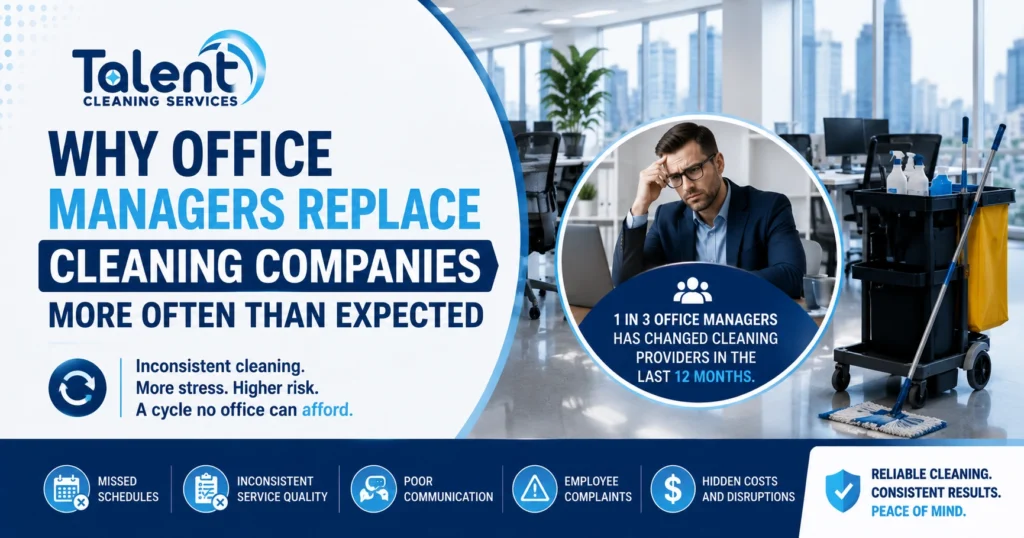
Office Managers replace cleaning companies more often than expected because the real failure is rarely a single missed task. Replacement happens when repeated inconsistencies create extra supervision, employee complaints, schedule disruptions, and uncertainty about whether the office will be ready for staff, clients, or leadership visits. At that point, the cleaning vendor is no longer removing work from the Office Manager. It is creating more work.
A reliable Office Cleaning Service should operate as quiet infrastructure. The scope is clear, the schedule is followed, cleaning standards remain consistent, and communication is handled before minor issues become recurring problems. When those conditions disappear, trust declines quickly. Managers begin documenting missed areas, following up on incomplete work, explaining complaints to leadership, and spending time checking a service they hired precisely so they would not have to manage it.
The decision to replace a provider usually occurs when the cost of oversight becomes greater than the perceived risk of changing companies. Price still matters, but operational reliability, responsiveness, accountability, and consistent results often carry more weight. Office Managers do not expect perfection. They expect a Professional Cleaning Service to identify problems, correct them promptly, and prevent the same failure from returning.
What Actually Pushes an Office Manager to Replace a Cleaning Company?
An Office Manager usually replaces a cleaning company when the relationship stops providing operational predictability. A clean office is expected, but the deeper requirement is knowing that agreed tasks will be completed correctly, at the scheduled time, without repeated reminders.
The replacement process often begins quietly. A conference room is not cleaned properly. Trash remains in one area. Restroom supplies are overlooked. Floors receive inconsistent attention. None of these incidents automatically ends a contract. The problem begins when the same categories of failure return after they have already been reported.
A cleaning company becomes vulnerable when the Office Manager can no longer answer basic operational questions with confidence:
- Will the cleaning team arrive as scheduled?
- Will the same areas be cleaned to the same standard?
- Will reported problems be corrected without another reminder?
- Will the office be presentable before employees and clients arrive?
- Will the vendor communicate when something affects the service?
These questions reveal why replacement decisions are not based only on visible cleanliness. They are based on trust in the service process. Once the manager feels compelled to inspect every visit, the relationship has already moved from routine maintenance to active vendor management.
Why Does Extra Supervision Become the Real Breaking Point?
Extra supervision becomes the breaking point because it transfers responsibility back to the person who outsourced it. The Office Manager hired a cleaning company to remove a recurring operational task from the internal workload. If that manager must create reminders, inspect restrooms, photograph missed areas, track attendance, and repeatedly request corrections, the service is no longer functioning as intended.
This creates an invisible cost that is rarely shown on an invoice. The company may still be paying the same monthly rate, but the Office Manager is contributing additional labor to keep the agreement working. That labor includes interruption, documentation, communication, complaint handling, and internal explanation.
The financial price of the contract may appear reasonable while the management cost becomes excessive. This is why a lower priced provider can become more expensive in practice than a company with stronger quality control and more consistent communication.
How Does a Cleaning Relationship Deteriorate Before the Contract Ends?
Most cleaning relationships deteriorate through accumulation rather than a single dramatic event. Each unresolved failure reduces confidence until replacing the company appears easier than continuing to manage it.
A common progression looks like this:
- A task is missed during one scheduled visit.
- The Office Manager reports the problem and expects a correction.
- The same issue returns or another part of the scope becomes inconsistent.
- Employees begin mentioning visible cleanliness problems.
- The manager starts checking completed work personally.
- Communication with the cleaning company becomes more frequent.
- The vendor responds to complaints but does not prevent recurrence.
- The Office Manager begins comparing alternative providers.
This sequence matters because the final replacement may appear sudden to the cleaning company even though the decision developed over several weeks or months. By the time a manager requests proposals from other providers, the current company may already have exhausted its opportunity to restore confidence.
What Is the Difference Between a Cleaning Mistake and a Service Failure?
A cleaning mistake is an isolated problem that is acknowledged, corrected, and prevented from becoming a pattern. A service failure occurs when the company lacks the process, supervision, communication, or accountability required to keep the problem from returning.
For example, one overlooked trash container may be a mistake. The same container being missed repeatedly after several reports indicates a failure in the checklist, team instruction, inspection process, or route design.
The distinction is important because experienced Office Managers understand that occasional mistakes can happen. What they evaluate is the provider’s response:
- Was the issue acknowledged clearly?
- Was it corrected within a reasonable operational window?
- Was the cause identified?
- Was the cleaning team informed?
- Did the problem remain resolved?
A professional response can preserve the relationship. A vague apology followed by the same failure damages it further. Office Managers judge reliability by what happens after a problem is reported, not only by whether a problem occurred.
Which Warning Signs Usually Appear Before a Cleaning Company Is Replaced?
The strongest warning signs are recurring failures that increase administrative work or create uncertainty. A single dirty surface may be noticeable, but a pattern of incomplete tasks indicates that the service system is losing control.
Common warning signs include:
- Repeatedly missed areas, such as conference rooms, workstations, break rooms, reception areas, restrooms, or interior glass
- Changing cleaning standards, where results depend on which crew member performs the work
- Missed or unpredictable visits that interfere with the established cleaning schedule
- Poor communication when staffing, access, timing, or service problems occur
- Recurring employee complaints about trash, odors, restrooms, floors, or shared spaces
- Temporary corrections that solve the problem for one visit but do not prevent it from returning
- Unclear accountability when no one takes ownership of reported issues
- Growing manager involvement in inspections, reminders, access coordination, and task verification
These signals become more serious when several appear together. An incomplete task can be corrected. An operating pattern involving inconsistent work, weak communication, and repeated complaints indicates that the vendor may no longer have the process required to support the account.
Why Are Employee Complaints More Important Than They Seem?
Employee complaints convert a cleaning issue into an internal management issue. Once staff members begin reporting dirty restrooms, full trash containers, neglected break rooms, dust, odors, or poorly maintained common areas, the Office Manager must respond.
The complaint itself takes time to receive, verify, document, and communicate. If the issue returns, employees may interpret the lack of correction as indifference from management rather than failure by an outside vendor. The Office Manager then carries the reputational cost inside the company.
Repeated complaints also indicate that the problem is visible enough to affect the workplace experience. Employees are not inspecting the cleaning contract. They are reacting to conditions they encounter while working. Their feedback often reveals that service inconsistency has moved beyond a minor technical issue.
Who Is Usually Involved in the Decision to Change Cleaning Providers?
The Office Manager or Facilities Manager is usually the person who identifies the problem, evaluates alternatives, contacts cleaning companies, and recommends the replacement. However, the final decision may also involve a business owner, managing partner, property manager, finance department, or senior leader.
Different participants evaluate different risks:
- The Office Manager evaluates reliability, communication, scheduling, and daily workload.
- Employees evaluate visible cleanliness and the condition of shared areas.
- Leadership evaluates professionalism, complaints, business appearance, and operational risk.
- Finance evaluates price, contract terms, and the cost of changing providers.
- Property management may evaluate access procedures, insurance requirements, building rules, and service coordination.
The Office Manager connects these concerns. That is why the winning cleaning company is not always the one with the lowest quote. It is often the provider that makes the decision easier to explain and defend through a clear scope, realistic schedule, professional communication, and consistent operating process.
When those elements are present, the manager can recommend a new provider with less perceived risk. When they are absent, even an attractive price may not be enough to justify another uncertain cleaning relationship.
When Should an Office Manager Correct the Relationship Instead of Replacing the Company?
An Office Manager should attempt to correct the relationship when the problem is isolated, the service scope is still appropriate, communication remains productive, and the cleaning company demonstrates that it can make a lasting correction. Replacing a provider after every minor mistake creates unnecessary disruption and does not guarantee better performance from the next company.
The current relationship may still be recoverable when:
- The problem appeared recently rather than developing over several months.
- The cleaning company acknowledged the issue without becoming defensive.
- A supervisor inspected the office and identified the cause.
- The provider proposed a specific corrective action.
- The cleaning crew received updated instructions.
- The next visits showed measurable improvement.
- Communication became more proactive after the complaint.
A corrective period should have a defined purpose. The Office Manager is not giving the company unlimited time to improve. The goal is to determine whether the provider can restore service consistency within a reasonable number of scheduled visits.
What Makes a Corrective Action Plan Credible?
A credible corrective action plan identifies what failed, why it failed, who will correct it, and how the company will verify that the issue does not return. General statements such as “we will speak with the team” provide no meaningful assurance because they do not establish accountability.
A useful corrective plan should explain:
- Which cleaning tasks were incomplete
- Whether the problem involved staffing, training, scheduling, access, supplies, or supervision
- What instructions will be changed
- Who will inspect future work
- How the Office Manager will receive confirmation
- What will happen if the problem returns
The explanation following these actions matters more than the apology itself. A company that understands the cause can change the process. A company that only apologizes may temporarily improve the visible result without correcting the operational weakness behind it.
How Many Opportunities Should a Cleaning Company Receive?
There is no universal number of opportunities because the severity and frequency of the problem matter more than the count. One serious security or access failure may justify immediate reconsideration. Several minor issues may justify a shorter corrective period before replacement.
A practical approach is to evaluate the next two to four scheduled visits. This provides enough time to determine whether the correction became part of the routine or only appeared immediately after the complaint.
The Office Manager should look for three indicators:
- The reported issue remains corrected
- Other parts of the cleaning scope remain consistent
- The provider communicates without waiting for another complaint
If performance improves for one visit and then declines again, the company has demonstrated reactive behavior rather than reliable quality control.
When Is Replacing the Cleaning Company the More Responsible Decision?
Replacing the cleaning company becomes the more responsible decision when repeated failures continue despite clear communication and reasonable opportunities to improve. At this stage, preserving the existing relationship may expose the business to more disruption than changing providers.
Replacement is usually justified when:
- The same tasks are repeatedly missed after being reported
- Cleaning quality changes significantly between visits or team members
- The provider cannot explain absences, delays, or incomplete work
- Employee complaints continue after corrective discussions
- Supervisors promise inspections that produce no lasting improvement
- The Office Manager must monitor each visit personally
- The company disputes obvious problems instead of resolving them
- Access procedures, keys, alarm instructions, or building rules are handled carelessly
- The vendor lacks a clear contact person with authority to solve problems
These conditions show that the issue is no longer limited to cleaning technique. The account has an operational management problem involving communication, supervision, documentation, or staffing.
Why Does Delaying Replacement Usually Make the Situation More Expensive?
Delaying replacement allows a weak service pattern to become part of the office routine. Employees learn that complaints may not be resolved. The Office Manager begins compensating for the provider. Leadership may notice the condition of the workplace. Urgent corrections become more frequent.
The cost of delay appears in several forms:
- More time spent inspecting completed work
- More messages, calls, photographs, and follow ups
- More interruptions caused by employee complaints
- More internal cleaning performed by administrative staff
- More emergency service requests before meetings or client visits
- More frustration surrounding access and scheduling
- More difficulty defending the vendor relationship to leadership
The problem is not that every inconvenience creates a large direct expense. The problem is that small expenses and interruptions repeat. Over time, the organization pays for the cleaning contract while also providing internal labor to manage its failures.
Where Do Cleaning Inconsistencies Create the Greatest Business Risk?
Cleaning inconsistencies create the greatest risk in spaces with high visibility, frequent use, hygiene requirements, or direct exposure to employees and visitors. Not every missed task has the same operational consequence.
Restrooms and break rooms often generate the fastest complaints because employees use them throughout the day. Reception areas and conference rooms may create greater reputational risk because clients and leadership see them. A dependable Office Cleaning Service should prioritize both categories instead of treating every square foot as if it carried the same operational importance.
Why Do Restroom Problems Accelerate Vendor Replacement?
Restroom problems accelerate replacement because they are highly visible, personally experienced, and difficult for employees to ignore. A dusty corner may remain unnoticed for several days. An empty soap dispenser, unpleasant odor, dirty fixture, or overflowing container creates an immediate reaction.
Restroom failures also raise questions beyond appearance. Employees may wonder whether the area was serviced at all, whether supplies are being checked, and whether cleaning procedures are being followed consistently.
When restroom complaints continue, the Office Manager must decide whether the provider lacks time, supplies, training, inspection, or attention. None of those possibilities inspires confidence in the broader cleaning operation.
Why Are Conference Rooms a Different Type of Risk?
Conference rooms may not create daily complaints, but their condition can affect important business moments. Interviews, leadership meetings, client presentations, vendor discussions, and training sessions often take place in these spaces.
A dirty conference room can remain unnoticed until shortly before a scheduled meeting. The Office Manager then faces an urgent problem with little time to request a correction. Administrative employees may have to clean the room themselves, move the meeting, or accept an unprofessional setting.
This is why cleaning frequency should reflect room use rather than room size alone. A smaller conference room used every day may require more consistent attention than a larger space used once a week.
How Much Does an Unreliable Cleaning Company Really Cost?
The real cost of an unreliable cleaning company includes the monthly invoice plus internal supervision, employee disruption, corrective cleaning, supply problems, and operational risk. Comparing providers only by contract price hides these secondary expenses.
A useful calculation is:
Total monthly cleaning cost equals the service invoice plus management time plus corrective expenses plus disruption costs.
The formula does not require perfect accounting. Its purpose is to reveal expenses that are usually ignored during a price comparison.
Which Hidden Costs Should an Office Manager Measure?
An Office Manager can review four categories of cost:
- Direct service cost
This is the amount shown on the cleaning company invoice. It may include recurring service, periodic tasks, supplies, or additional requests depending on the agreement.
- Management time
This includes inspections, complaint documentation, follow ups, scheduling corrections, access coordination, and conversations with the vendor.
- Corrective cost
This includes emergency cleaning, internal staff time, replacement supplies, or additional service required because scheduled work was incomplete.
- Business disruption
This includes interrupted employees, delayed meetings, complaints, leadership involvement, and the reputational effect of visibly neglected spaces.
The fourth category is difficult to price precisely, but it should not be treated as worthless merely because it does not appear on an invoice. Operational disruption consumes attention, and attention is a limited business resource.
What Does the True Cost Look Like in a Practical Example?
Consider a fictional office paying $1,850 per month for recurring cleaning. The price initially appears competitive. However, the Office Manager spends five hours each month inspecting work, documenting issues, and contacting the provider.
If the manager’s internal labor cost is estimated at $50 per hour, supervision adds $250 per month. Employee complaints and internal corrections consume another three combined hours at an estimated $40 per hour, adding $120. One corrective visit or emergency cleaning request adds another $180.
The actual monthly cost becomes:
Now consider a Professional Cleaning Service charging $2,150 per month but requiring only one hour of management attention. With $50 in supervision cost and no recurring corrective expense, the estimated monthly total becomes $2,200.
The higher proposal is $200 less expensive in actual operational terms. These numbers are illustrative, not market pricing, but they demonstrate why the lowest invoice does not always represent the lowest cost.
Why Is Management Time Commonly Missing From Vendor Comparisons?
Management time is commonly ignored because the Office Manager is salaried and the company does not receive a separate invoice for each interruption. The time still has value. Every hour spent managing cleaning failures is an hour unavailable for staffing, purchasing, facilities coordination, employee support, scheduling, or other responsibilities.
If the current scope has gradually pushed inspections, supply checks, and repeated follow ups onto internal staff, documenting inconsistent office manager cleaning responsibilities can reveal how much work has shifted away from the vendor.
This documentation also makes the replacement decision easier to explain. Instead of telling leadership that the company is simply dissatisfied, the Office Manager can show how service failures create measurable administrative work.
Why Does Choosing the Lowest Proposal Often Lead to Faster Vendor Turnover?
The lowest proposal can lead to faster turnover when the price depends on unrealistic labor time, insufficient supervision, inadequate staffing, or a scope that excludes tasks the office expects to receive. A low price is not automatically a problem, but it should be examined against the actual service requirements.
A proposal may be artificially attractive when it does not clearly account for:
- Office size and layout
- Number of employees
- Restroom count and usage
- Break room usage
- Floor types
- Cleaning frequency
- Building access requirements
- Waste volume
- Supply responsibilities
- Periodic cleaning tasks
- Quality inspections
- Communication and account supervision
A provider that underestimates the work may initially attempt to meet expectations. Over time, crews may rush, rotate frequently, skip lower visibility tasks, or reduce the attention given to the account. The contract remains active, but the service becomes progressively less dependable.
What Is the Difference Between a Lower Price and an Incomplete Scope?
A lower price may reflect an efficient operating model, a smaller scope, a different frequency, or fewer included services. An incomplete scope fails to define responsibilities clearly enough for the Office Manager to understand what will and will not be completed.
For example, a proposal may say that floors, restrooms, trash, and common areas are included. That language sounds comprehensive but leaves important questions unanswered:
- How often are workstations dusted?
- Is interior glass included?
- Who restocks restroom supplies?
- Are break room appliances cleaned externally?
- How are conference rooms checked?
- Are periodic floor services included or quoted separately?
- What happens when a scheduled visit is missed?
- Who verifies that the service was completed?
These questions do not represent excessive micromanagement. They establish whether the proposal matches the office’s actual expectations. A clear scope reduces future disputes because both parties understand what constitutes complete service.
Why Do Office Managers Sometimes Replace a Cleaning Company Even When the Office Looks Acceptable?
Office Managers sometimes replace a company even when the office looks acceptable because visible appearance is only one part of the service relationship. A manager may be dealing with unpredictable arrival times, poor communication, repeated access problems, unreported staffing changes, supply shortages, or inconsistent responses behind the scenes.
Employees and leadership may see a reasonably clean workplace while the Office Manager is doing extensive work to keep it that way. This creates a misleading picture. The visible result appears acceptable because the manager is compensating for weaknesses that other people cannot see.
A cleaning relationship is sustainable only when the result and the process are dependable. If acceptable cleanliness requires continuous intervention, the service is not truly reliable. It is being held together by internal management effort that should never have been necessary.
How Should an Office Manager Evaluate the Current Cleaning Company Objectively?
An Office Manager should evaluate the current cleaning company through documented patterns, not frustration from one disappointing visit. The goal is to determine whether the provider has an isolated performance problem, an unclear scope, or a structural inability to deliver consistent service.
A fair evaluation should examine:
- Frequency of failures
Determine how often agreed tasks are missed and whether the problems occur in the same areas.
- Severity of each problem
A missed waste container does not carry the same operational risk as an unsecured door, mishandled key, ignored alarm instruction, or unsanitary restroom.
- Response quality
Measure how quickly the provider acknowledges the problem, communicates a solution, and completes the correction.
- Recurrence after correction
Identify whether the problem remains resolved or returns after the immediate complaint receives attention.
- Internal management time
Record the time spent inspecting, documenting, explaining, and following up on cleaning issues.
- Effect on employees and visitors
Review complaints, workplace interruptions, visible conditions, and situations that affected meetings or client interactions.
This evaluation separates dissatisfaction from evidence. It also prevents the replacement process from becoming an emotional decision that cannot be explained clearly to leadership, finance, or another decision maker.
What Should Be Included in a Cleaning Performance Record?
A cleaning performance record should document enough information to reveal patterns without turning the Office Manager into a full time cleaning inspector. The record is not intended to capture every fingerprint or isolated imperfection. It should identify failures that affect the agreed scope, workplace experience, security, hygiene, or administrative workload.
A practical record can include:
- Date and scheduled service period
- Office area affected
- Agreed task that was incomplete
- Photograph when useful and appropriate
- Date the cleaning company was notified
- Provider response
- Corrective action promised
- Date the correction was completed
- Whether the same problem returned
- Approximate management time required
The explanation after each incident should remain factual. “Restroom was unacceptable” is subjective. “Two soap dispensers were empty at 8:30 a.m. after the scheduled evening service” provides a condition, location, and time that the provider can investigate.
How Can a Simple Scorecard Reveal a Service Pattern?
A scorecard can convert several weeks of observations into a structured comparison. The categories should reflect the office’s actual priorities rather than a generic cleaning standard.
The scorecard does not need a complicated numerical formula. Its value comes from showing whether deficiencies are isolated or connected. Poor attendance, inconsistent results, and weak communication appearing together suggest a provider management problem rather than a single cleaning error.
What Should Be Defined Before Requesting New Cleaning Proposals?
Before requesting proposals, the Office Manager should define the office’s actual service requirements. Without that preparation, companies may quote different scopes, frequencies, labor assumptions, and supply responsibilities. The prices will appear comparable even though the services are not.
The service profile should identify:
- Approximate cleanable space
- Number of employees using the office
- Number and type of restrooms
- Break rooms, kitchens, and food preparation areas
- Conference rooms and their usage
- Reception and client facing areas
- Private offices and shared workstations
- Floor materials and current condition
- Waste volume and disposal requirements
- Preferred cleaning days and service periods
- Building access, parking, elevator, and security procedures
- Restroom and consumable supply responsibilities
- Periodic services that may require separate scheduling
- Areas with restricted access or special instructions
These details allow each Office Cleaning Service to evaluate the same operating environment. They also reduce the risk of receiving a low proposal that later increases because important conditions were not disclosed.
Why Is a Walkthrough Necessary Before a Reliable Proposal?
A walkthrough allows the cleaning company to inspect the office, verify the information provided, identify operational constraints, and ask questions before recommending a scope. Square footage alone does not reveal how difficult an office is to maintain.
Two offices of similar size may require very different service plans. One may have mostly private offices, low daily traffic, and simple flooring. Another may have shared workstations, several restrooms, frequent client meetings, food service areas, glass partitions, and heavy entrance traffic.
During the walkthrough, the Office Manager should observe whether the representative:
- Examines high use areas instead of only measuring the total space
- Asks about employee count, visitor traffic, and operating hours
- Reviews floor types and current maintenance needs
- Discusses restroom usage and supply responsibilities
- Confirms waste removal procedures
- Reviews access, alarm, key, and building requirements
- Identifies tasks that require periodic service
- Asks what is not working with the current provider
- Explains how quality will be checked after service begins
A thorough walkthrough does not guarantee excellent performance, but a superficial walkthrough increases the chance that the proposed labor, frequency, and scope will not match the office.
How Should Competing Cleaning Proposals Be Compared?
Competing proposals should be compared by scope, frequency, accountability, staffing, communication, and total operating value. Comparing only the monthly price rewards ambiguity and makes underpriced proposals appear stronger than they are.
A proposal is stronger when responsibilities are specific enough to be verified. Broad language may make a document easier to read, but it also leaves room for disagreement after service begins.
Which Questions Reveal Whether a Provider Can Deliver Consistent Service?
The most useful questions focus on operating procedures rather than promotional claims. An Office Manager needs to understand what the company will do when normal conditions change.
Relevant questions include:
- Who will manage our account after the agreement is signed?
- How are cleaning team members trained for a specific office?
- What happens when a regular team member is unavailable?
- How is completed work inspected?
- How are missed tasks documented and corrected?
- How will schedule changes be communicated?
- Who can authorize a corrective visit?
- How are keys, access codes, and alarm instructions protected?
- How are special requests added to the existing scope?
- How are supply levels monitored when restocking is included?
- What information will you need from our Office Manager?
- How will the first month be reviewed?
The quality of the answers matters more than the confidence with which they are delivered. A credible provider explains responsibilities, communication paths, and corrective procedures in practical terms.
What Answers Should Make an Office Manager More Cautious?
Vague answers deserve further investigation when they concern core operating responsibilities. Statements such as “our team handles everything” or “we have never had that problem” do not explain how the account will be managed.
Caution is appropriate when:
- The proposal does not identify service frequency clearly
- The company cannot explain who manages complaints
- Quality control depends entirely on the Office Manager reporting problems
- Replacement staffing is discussed without a communication procedure
- Access and security questions receive casual answers
- The provider promises every requested task without considering available service time
- Periodic services are mentioned but not defined or priced
- The company discourages clarification about exclusions
These conditions do not automatically disqualify a provider. They show where the Office Manager should request written clarification before making a commitment.
What Makes a Cleaning Company a Lower Risk Choice?
A lower risk cleaning company demonstrates that service quality is supported by a repeatable operating process. The company does not rely exclusively on one dependable cleaner, verbal instructions, or the Office Manager’s willingness to identify every failure.
A reliable commercial cleaning partner should provide clarity in five areas:
- Scope clarity
The Office Manager understands which tasks are included, how often they occur, and which services require separate approval.
- Accountability
A specific contact receives concerns, coordinates corrections, and has authority to resolve recurring issues.
- Service continuity
The provider has a process for absences, schedule changes, and team transitions.
- Quality verification
Work is checked through supervision, inspections, checklists, communication, or another defined control method.
- Service recovery
When a problem occurs, the provider acknowledges it, corrects it, and updates the process when necessary.
These elements reduce dependence on personal promises. A strong relationship may still involve occasional mistakes, but the system keeps those mistakes from becoming recurring administrative problems.
Why Does Staffing Continuity Matter More Than Having the Same Cleaner Forever?
Staffing continuity means maintaining consistent instructions and service standards even when individual team members change. Expecting the same cleaner forever is unrealistic because employees may become unavailable, change schedules, or leave the company.
The provider should be able to preserve account knowledge through documented procedures. Important information includes access instructions, cleaning priorities, restricted areas, task frequencies, supply responsibilities, and known office preferences.
When account knowledge exists only in one person’s memory, every staffing change creates a new learning period for the Office Manager. The manager must explain the office again, monitor the new cleaner, and report failures that the previous cleaner had already learned to avoid.
A Professional Cleaning Service reduces this disruption by treating instructions as company knowledge rather than personal knowledge.
How Should Quality Control Work Without Creating More Work for the Office Manager?
Quality control should identify and correct problems without requiring the Office Manager to inspect every service. The manager may still provide feedback, but that feedback should support the process rather than replace it.
An effective quality process can include:
- A location specific cleaning scope
- Team instructions linked to the office layout
- Supervisor inspections at appropriate intervals
- Documentation of reported deficiencies
- Confirmation after corrective service
- Review of recurring complaints
- Updates when office usage or priorities change
No single inspection method is suitable for every office. The essential requirement is that someone within the cleaning company remains responsible for verifying performance.
What Are the Advantages and Disadvantages of Replacing a Cleaning Company?
Replacing an underperforming cleaning company can reduce management burden and restore predictability, but the transition requires preparation. The Office Manager should compare the continuing cost of the current relationship with the temporary effort and uncertainty involved in changing providers.
The correct choice depends on the provider’s ability to make lasting corrections. Remaining with a weak company simply to avoid transition work is often a false economy. The business avoids a temporary onboarding task but accepts recurring operational friction without a clear end.
How Can an Office Manager Change Cleaning Companies Without Disrupting the Office?
A controlled transition begins before the current service ends. The Office Manager should review the existing agreement, confirm notice requirements, select the new provider, establish access procedures, and document the new scope before the first scheduled visit.
A practical transition can follow these steps:
- Review the current agreement and required notice.
- Confirm the final service date and any outstanding invoice or supply responsibility.
- Select the new provider and approve the written scope.
- Designate the internal contact and the cleaning company contact.
- Document access, alarm, parking, elevator, and building procedures.
- Identify restricted rooms, confidential areas, and special instructions.
- Confirm the service calendar and first visit.
- Recover keys, badges, codes, or other access items from the previous provider.
- Complete a starting condition review with the new company.
- Evaluate the first several visits against the approved scope.
The transition should create a clear transfer of responsibility. Overlapping access without defined ownership can create confusion about who completed the work, who moved supplies, or who handled security procedures.
What Should Happen Before the First Cleaning Visit?
Before the first visit, the cleaning company should understand the office layout, service scope, schedule, access procedure, supply arrangement, priority areas, and communication path. The Office Manager should not assume that every detail discussed during sales was automatically transferred to the cleaning team.
Early feedback should be specific and proportionate. The goal is to confirm that the written scope has been translated into the correct routine, not to create a permanent inspection burden for the Office Manager.
How Should Access and Security Be Transferred?
Access should be transferred through a documented process that identifies which keys, badges, codes, doors, elevators, alarms, and restricted areas are involved. The Office Manager should follow the company’s internal security policies and any building management requirements.
The transition may require:
- Recovering access items from the previous provider
- Deactivating credentials that should no longer work
- Recording items issued to the new provider
- Confirming alarm entry and exit instructions
- Identifying areas the cleaning team may not enter
- Establishing a process for reporting lost or damaged access items
- Confirming who should be contacted if access fails
After these actions are completed, the Office Manager should verify that responsibility is clear. Security procedures should never depend on informal assumptions or instructions passed verbally from one cleaning team to another.
What Mistakes Cause Office Managers to Choose Another Unsuitable Provider?
The most common selection mistake is solving only the visible problem. If the current company misses tasks, the Office Manager may choose the next provider based on promises of better cleaning while ignoring communication, supervision, staffing, and scope clarity.
Other common mistakes include:
- Requesting quotes before defining the service requirements
- Comparing monthly prices without comparing included tasks
- Assuming every cleaning company uses the same definition of standard service
- Accepting verbal promises that do not appear in the written scope
- Failing to discuss replacement staffing
- Ignoring access and security procedures
- Selecting a frequency that does not match office usage
- Expecting the provider to infer priorities after service begins
- Failing to establish a clear contact person
- Skipping the performance review during the first month
These mistakes recreate the same conditions that caused the original relationship to fail. Changing the company name on the invoice will not improve the result if the scope remains unclear and accountability remains undefined.
Why Is the Best Replacement Decision Based on Reduced Management Work?
The best replacement decision is the one that creates a cleaner office with less internal intervention. A provider should not be judged only by how impressive the proposal sounds or how low the monthly invoice appears.
The real test is operational:
Can this company follow the agreed schedule, deliver consistent results, communicate clearly, correct problems, and manage normal staffing changes without transferring responsibility back to the Office Manager?
When the answer is supported by a clear scope and credible operating process, the new relationship has a stronger chance of becoming what office cleaning should be: a dependable business function that works quietly in the background.
How Should the First Month With a New Cleaning Company Be Evaluated?
The first month should confirm whether the new cleaning company can translate its written scope into a dependable routine. The Office Manager should review service quality, schedule consistency, communication, access procedures, supply responsibilities, and corrective response without creating permanent supervision duties.
Some adjustment may be reasonable during the first few visits because the cleaning team is learning the office layout, usage patterns, priority areas, and building procedures. However, onboarding should produce steady improvement. It should not become an excuse for repeated failures.
The Office Manager should determine whether:
- Scheduled visits occurred at the agreed times.
- Priority areas received consistent attention.
- Cleaning standards remained stable between visits.
- Access instructions were followed correctly.
- Reported problems were corrected promptly.
- The same deficiencies returned after correction.
- Communication reduced uncertainty rather than creating more questions.
- The approved scope matched the service actually delivered.
The purpose of this review is not to demand perfection from the first visit. It is to confirm that the provider can learn, communicate, adjust, and establish a routine that requires progressively less involvement from the Office Manager.
What Should Be Reviewed After the First Week?
After the first week, the Office Manager should review the areas most likely to expose a mismatch between the proposed service and the actual office environment. These usually include restrooms, break rooms, entrances, floors, conference rooms, waste removal, and consumable supplies when restocking is part of the agreement.
Feedback should identify the location, condition, expected task, and required correction. A statement such as “the cleaning was poor” gives the provider little useful direction. A statement explaining that conference room tables remained dusty after two scheduled visits creates a specific issue that can be investigated.
The Office Manager should also confirm whether sales information reached the cleaning team. If restricted areas, access procedures, task frequencies, or supply responsibilities were discussed during the walkthrough but ignored during service, the provider may have an internal communication problem.
What Should Happen If Performance Slips During Onboarding?
If performance slips during onboarding, the cleaning company should determine whether the cause involves unclear instructions, insufficient service time, staffing, training, access, equipment, supplies, or supervision. The response should address the cause instead of correcting only the visible result.
The Office Manager should expect a specific explanation, a corrective action, and confirmation that the team received updated instructions. If the same issue returns after that process, the problem may be structural rather than transitional.
A new provider that requires constant intervention during the first month may not become easier to manage later. Onboarding should reduce uncertainty with each visit. It should not establish a new version of the same management burden that caused the previous company to be replaced.
Frequently Asked Questions About Replacing an Office Cleaning Company
How Often Do Office Managers Replace Cleaning Companies?
There is no standard replacement schedule for an office cleaning company. A productive relationship can continue for years when the scope remains appropriate, service stays consistent, and the provider adapts to changes in office usage.
Frequent replacement usually indicates recurring problems with quality, communication, staffing, scope definition, or vendor selection. It may also reveal that the office keeps choosing providers based primarily on monthly price without evaluating how the service will be managed.
The relevant question is not how long the current company has been under contract. The relevant question is whether the provider continues to deliver the agreed result without creating excessive internal work.
Is One Missed Cleaning Visit Enough to Replace a Company?
One missed visit does not automatically justify replacement when the provider communicates promptly, explains the cause, arranges a reasonable correction, and prevents recurrence. Unexpected staffing, access, or scheduling problems can occur in any service business.
The situation becomes more serious when the company fails to communicate, leaves the office without a recovery plan, or repeatedly misses scheduled visits. A missed service affects waste removal, restroom conditions, shared spaces, meetings, and the next working day.
The Office Manager should evaluate the severity of the event and the quality of the response. Reliability is demonstrated through recovery as well as routine performance.
Should an Office Manager Warn the Current Company Before Requesting Proposals?
An Office Manager can request proposals without informing the current provider, especially when the goal is to understand available scopes and pricing. However, the existing agreement should be reviewed before any termination decision is made.
If the relationship may still be recoverable, a documented corrective conversation can provide the company with a final opportunity to improve. If serious access, security, dishonesty, or repeated performance failures are involved, the organization may decide that further warning would not change the outcome.
The appropriate approach depends on the agreement, internal purchasing procedures, risk level, and whether the provider has already received clear opportunities to correct the problem.
What Evidence Should Be Collected Before Ending the Agreement?
Useful evidence includes dates of missed visits, incomplete tasks, employee complaints, photographs when appropriate, messages sent to the provider, corrective actions promised, recurring failures, and the amount of management time required.
Documentation should remain factual and connected to the approved scope. It should show what was expected, what occurred, when the provider was notified, and whether the problem returned.
This information helps leadership understand that replacement is based on an operating pattern rather than personal preference. It can also help the next provider design a more accurate scope around the conditions that caused the previous relationship to fail.
Should Employee Complaints Determine Whether a Cleaning Company Is Replaced?
Employee complaints should influence the evaluation, but they should not be the only evidence used. Some complaints may reflect isolated conditions, personal expectations, or tasks that were never included in the cleaning scope.
Repeated complaints about the same restrooms, break rooms, odors, waste containers, floors, or shared spaces deserve investigation. They may reveal that service failures are visible across the workplace and are affecting employee confidence in office maintenance.
The Office Manager should verify the complaint, compare it with the agreed responsibilities, and determine whether the provider corrected the cause. Complaints become strong replacement evidence when they are valid, recurring, and unresolved.
Can a More Expensive Cleaning Company Still Be the Lower Cost Option?
Yes. A more expensive proposal can produce a lower total operational cost when it requires less supervision, prevents recurring corrective work, improves supply control, and reduces employee complaints.
The monthly invoice represents only the direct service cost. The organization may also be paying through Office Manager time, administrative interruptions, internal cleaning, emergency requests, leadership involvement, and disrupted meetings.
A higher price does not guarantee reliability. It becomes financially stronger only when the provider offers a complete scope and a credible process that reduces hidden management costs.
Does a Lower Price Always Mean the Scope Is Incomplete?
No. A lower price may reflect an efficient operating model, lower overhead, a different service frequency, or a carefully designed scope. Price alone cannot reveal whether a proposal is appropriate.
The Office Manager should compare task frequency, cleanable space, restroom usage, employee count, floor types, supplies, periodic services, access requirements, supervision, and corrective procedures.
A lower proposal becomes risky when the company cannot explain how the work will be completed within the proposed service plan. If important responsibilities remain undefined, the apparent savings may disappear after service begins.
How Much Should an Office Cleaning Service Cost?
The cost of an Office Cleaning Service depends on the cleanable area, office layout, employee traffic, restroom count, cleaning frequency, floor materials, waste volume, access conditions, supply responsibilities, and periodic service requirements.
A dependable estimate usually requires more than total square footage. Two offices of equal size can require different labor because one has more restrooms, shared spaces, glass, food areas, visitors, or security procedures.
Office Managers should avoid using a universal price as the primary selection standard. The useful comparison is the cost of delivering the same defined scope at the required frequency and quality level.
What Should Be Included in a Commercial Cleaning Agreement?
A commercial cleaning agreement should define the recurring scope, task frequency, service schedule, price, billing terms, supply responsibilities, communication contacts, access procedures, excluded services, corrective process, and termination requirements.
The agreement should also explain how additional work is approved and priced. Periodic floor care, interior glass, deep cleaning, event support, and other tasks may require separate scheduling depending on the provider and office.
Clear language protects both parties. The Office Manager knows what can be verified, and the cleaning company knows what it is responsible for delivering.
Should an Office Manager Inspect Every Cleaning Visit?
No. An Office Manager should not need to inspect every visit indefinitely. Temporary review may be appropriate during onboarding, after a major scope change, or while a corrective plan is being evaluated.
Permanent inspection transfers quality control from the provider to the client. It also hides the true weakness of the service because the office may appear consistently maintained only through internal supervision.
A Professional Cleaning Service should have its own method for communicating instructions, checking performance, documenting deficiencies, and correcting problems. Client feedback should support that process rather than replace it.
Can a Cleaning Company Recover After Repeated Complaints?
A cleaning company can recover when it identifies the cause, changes the operating process, communicates clearly, and sustains improvement across several visits. A sincere apology is useful, but it does not demonstrate that the problem has been resolved.
Recovery becomes less likely when the company repeatedly promises improvement without changing staffing, supervision, instructions, service time, or accountability. Temporary attention immediately after a complaint is not the same as consistent service.
The Office Manager should evaluate behavior rather than promises. A recoverable relationship becomes easier to manage after corrective action. An unrecoverable relationship returns to the same pattern.
What Is the Strongest Sign That a Provider Will Be Reliable?
The strongest sign is a repeatable service process that does not depend entirely on one cleaner or one verbal promise. The provider should be able to explain how the scope is communicated, how absences are covered, how performance is checked, and how deficiencies are corrected.
Reviews, references, presentation, and price can support the decision, but none replaces operational clarity. A reliable provider understands that Office Managers are buying predictability as well as visible cleanliness.
The company should make it clear who owns the account after the proposal is signed. Responsibility should not disappear between the sales conversation and the first cleaning visit.
How Important Are Online Reviews When Choosing a Cleaning Company?
Online reviews can reveal patterns involving reliability, communication, professionalism, and service recovery. They are useful when several reviewers describe similar experiences over time.
Reviews should not be treated as complete proof. A high rating does not confirm that the company has the staffing, experience, or operating process required for a particular office. The Office Manager still needs a walkthrough, written scope, clear communication path, and answers about quality control.
Reviews help reduce uncertainty, but the final decision should reflect the needs and risks of the actual workplace.
How Soon Should the New Provider Be Selected?
The new provider should be selected early enough to complete the walkthrough, approve the scope, review insurance or building requirements, establish access, and prepare the cleaning team before the existing service ends.
The exact timing depends on the current agreement and the complexity of the office. A smaller location with simple access may require less preparation than a larger office with alarms, restricted areas, building management rules, and several decision makers.
Rushing the selection increases the risk of accepting another vague proposal simply because the office needs immediate coverage. A controlled transition protects service continuity and allows the Office Manager to compare providers on more than availability.
How Can an Office Avoid Replacing Cleaning Companies Repeatedly?
The office can reduce repeated turnover by defining requirements before requesting proposals, conducting a detailed walkthrough, comparing equivalent scopes, documenting responsibilities, and reviewing performance during the first month.
The organization should also examine whether its own expectations, access procedures, communication, and service frequency are clear. A cleaning company cannot consistently deliver tasks that were never defined or provide enough labor when the approved frequency does not match office usage.
Provider accountability remains essential, but selection quality matters. Repeated turnover often continues when each new company is hired through the same incomplete decision process.
What Should an Office Manager Do Next?
An Office Manager should begin by measuring whether the current cleaning company removes operational work or creates it. Service quality, communication, attendance, corrective response, employee complaints, security procedures, and management time should be evaluated together.
If the provider can make a lasting correction, a defined improvement period may preserve the relationship. If recurring failures continue and internal supervision keeps increasing, replacement becomes a responsible operating decision rather than an emotional reaction.
The next provider should be chosen through a clear scope, an onsite walkthrough, equivalent proposal comparison, documented access procedures, and a structured first month review. The objective is not merely to find another company that cleans. It is to establish a dependable service that functions without forcing the Office Manager to manage every visit.
If your current provider has become another responsibility on your schedule, request a walkthrough and compare the real scope, accountability, and operating process before making the next decision.